
 Card Game DB

 Sign In
 Create Account
Welcome to Card Game DB
Register now to gain access to all of our features. Once registered and logged in, you will be able to create topics, post replies to existing threads, give reputation to your fellow members, get your own private messenger, post status updates, manage your profile and so much more. If you already have an account, login here - otherwise create an account for free today!
Register now to gain access to all of our features. Once registered and logged in, you will be able to create topics, post replies to existing threads, give reputation to your fellow members, get your own private messenger, post status updates, manage your profile and so much more. If you already have an account, login here - otherwise create an account for free today!
 2
2

First Tilt - Deck Archetypes: Lannister
Oct 16 2012 05:00 AM |
doulos2k
in Game of Thrones
Small Council First Tilt doulos2k Welcome back to First Tilt! I apologize for the long absence, but we're back! ((yay)) Today we're hitting the final article in our current series on House deck archetypes. Remember that this series is aimed at newer players by newer players, so we're really trying to define some of the basic archetypes that people hear mentioned a lot when they start to get into this game. If you haven't read the previous articles, I encourage you to do so as we cover a lot of basics in those articles that I won't get too far into for this final article in the series.
Today, we visit the rich lands of Casterly Rock. This opulent house is the current power behind the throne and they wield this power with pride and great skill causing most of their enemies to either kneel in submission or watch helplessly as their resources are stripped away. Adding to their power, they're never afraid to use whatever dogs they can find to do their bidding - even Tyrion's barbarous Clansman. Whatever keeps them in power.
As we've discussed in the previous articles, there are three typical builds: Aggro, Control, and Rush. Lannister tends to excel at both Control and Aggro while they don't tend to field very many decks that actually qualify as a pure Rush build. So, with this in mind, for Control, we'll be looking at the classic Hyperkneel deck type. For Aggro, we'll be looking at Power Behind the Throne and Clansman.
Key Cards
As always, there are a few key cards that you're going to find in most decks, regardless of type.
- Golden Tooth Mines (Core) - constant, repeatable card draw right before you need it (in Marshaling). A boon in any deck.
- Ser Arys Oakheart (PotS) - a solid character that allows you to choose and discard an Ally or Mercenary? Yes, please.
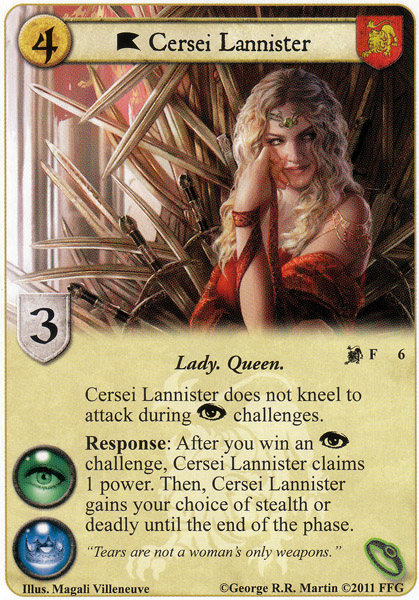
- Cersei Lannister (LotR) - the question just becomes how many of her do you include? It depends on the deck's focus, but having a non-kneeling Intrigue beast at the ready is a no-brainer include
- Doubting Septa (LotR) - very inexpensive card that ends up in almost every Lannister deck because she has no real downside. She can't die and she draws you a card when she leaves play.
- The Iron Throne (LotR) - repeatable cancel that you should be including if you aren't. It only ever potentially gets shut off in a mirror match or against Baratheon. In every other game, it will help you to maintain momentum while interrupting your opponent's
- At least some copies of the income generating characters. Non-limited income generation with actual icons. Which one you choose tends to depend upon which icon you need to shore up:
- Lannisport Councilor (RotO) - power icon
- Lannisport Moneylender (LotR) - intrigue icon
- Lannisport Weaponsmith (Core) - military icon
- Lannisport Steward (Core) - more expensive, but gives 2 gold and the intrigue icon
This could be called the "original" deck archetype for Lannister. From the Core Set forward, Lannister kneel was a greatly feared deck. What good is it to field characters if your opponent is just going to kneel them? This is what would be considered the ultimate type of control. You're not only preventing characters from participating in challenges, they can't count their strength for dominance and many of them are unable to initiate their effects. It can be utterly brutal to play against as you stare at your completely knelt board.
So, the goal of this deck type is exactly what I've stated - kneel, then kneel some more, and then when you're done with that... kneel even more. In recent years, this deck archetype fell out of favor with all of the additional standing effects and cancels. Lannister found it harder to successfully keep the opponent's board knelt. When the Lions of the Rock expansion came out, the Lannister field become flooded with Power Behind the Throne decks. But, by and large, those decks weren't really winning many tournaments. Now, we've seen a resurgence in kneel and it's been bolstered by some new cards. Let's take a look.
- Castellan of the Rock (BoRF) - long the Restricted card of choice. It's a Limited Response, but the response is free. Just play a Lannister card and then kneel something. It's that easy. Including this is usually a no-brainer, unless you decide to go Shadows heavy... then you should opt for...
- Alchemist's Guild Hall (TBoBB) - kneel a card whenever a card comes out of Shadows. Like Castellan, this is a Limited Response, so you usually reserve this for a dedicated Shadows build and then leave Castellan at home (since you can only ever trigger one per turn)
- Lannisport Brothel (Core) - a beast that will completely tick off your opponent because it kneels any character that has just stood in the Standing phase. It is expensive and it is unique (it was errata'd a while back to be unique), but it is definitely a card to consider
- Brothel Guard (LotR) - vicious card that can be used during challenges and then when it stands, kneels a card. Wait, what? Yep. The character is already a decent choice for an Intrigue-heavy deck, but that effect is MONEY. And if they decide to pay you gold or kneel influence to prevent the kneel... great! They've just given you power. And who doesn't want more power? Want to really mess with your opponent? Combo this with Toll Gate.
- Enemy Informer (Core) - so, this evens out your curve and kneels a character when it comes into play... nice!
- Lannisport Tourney Grounds (ODG) - you're probably not running unique heavy in a dedicated kneel deck, but this is worthy of consideration in any kneel deck
- Volantis Inn (AHM) - a newer card and you do have to kneel one of your own characters, but this can be effective and if you're already running the Brothel Guard/Toll Gate combo you have even more reasons to run this
- You've Killed the Wrong Dwarf! (Core) - when I first looked at this card, I thought it was crazy that anyone would use this offensively as giving power away is usually a bad thing, but if you use this as a means to kneel out that one character that prevents you gaining unopposed challenges that turn... could be all you need.
- Cersei's Attendant (Core) - inexpensive character that can be used for claim soak with the added benefit of kneeling a character as she dies. Odd little tidbit, if your opponent happens to also be playing Lannister and their Cersei dies... you can still trigger this response. Weird, huh? Note, though, that this doesn't work if another Cersei's Attendant dies because that falls under the self-referential rule and, therefore, can only, um, refer to itself.
- Distraction (Core) - straight up kneel a Military icon... I'd say that Army over on your opponent's board looks pretty ripe for this event
- Joffrey Baratheon (LotR) - if the meta skews away from non-unique characters, he may not be as helpful as he has been; however, it's still a solid choice (remember, most Army characters are still non-unique)
- Edict of the Rock (LotR) - this can be a hard include because it hits your characters as well and a smart opponent can work around this, but worth a mention here
One technique commonly employed is to ensure you include as many characters as you can with both an Intrigue icon and the Deadly keyword. Also, don't be afraid to toss in a few kneel effects if they fit - anything that will help you push through the multiple Intrigue challenges is going to be a safe bet.
The most common characters for this deck type are:
- Cersei Lannister (LotR) - almost universally considered the backbone of this deck type - she is a game winning card. Two non-kneeling intrigue challenges and then a power challenge and by the power challenge, she's usually got both stealth and deadly (along with some power).
- Bronn's Hireling (LotR) - an inexpensive Intrigue character with the Deadly keyword
- House Payne Enforcer (MotA) - still relatively inexpensive Deadly character, one more STR than the Hireling and also adds the Military icon which can be critical in some matchups
- Lady Genna (CbtC) - a nice card to have if someone decides to surprise you by winning an Intrigue challenge (like Stark can by jumping in Catelyn Stark (LoW))
- Myrcella Lannister (LotR) - a tough include because you have to discard her to get that extra challenge, but it can be gold when done at the right time
- I'm You Writ Small (Core) - has the advantage of creating a surprise Deadly challenge (when played during the Player Action window after defenders are declared).
- Terminal Schemes (LotR) - pretty much a staple for this deck type, targeted kill is pretty unexpected in most Intrigue challenges
- Wars Are Won with Quills (PotS) - plays double duty as either a defensive or offensive card, pick up the intrigue win and push through or prevent the military challenge
- Misinformation (TWH) - yeah, I know - why would you include such a card in a deck that should never lose an Intrigue challenge? Because this is a deck that's designed to do multiple Intrigue challenges. The flexibility have this event in hand will give should not be underestimated. Not only that, it can prevent your opponent from using your own agenda against you
- Frey Hospitality (LotR) - an auto-include for this deck type, it makes every Intrigue challenge all that more brutal
- Game of Thrones (LotR) - giving all of your characters the ability to not kneel during Intrigue can be a huge power swing for you
- Breaking and Entering (LotR) - with the number of intrigue challenges you should be winning, this card is a must. Plus, it's 2-claim.
- Bay of Ice (KotS) - because you really, really want to do everything you can to go first. Really.
This is primarily another Aggro deck, but it has a series of Shagga-like elements to it. This deck isn't as simply as throwing a whole bunch of Clansman in the deck and hoping you just overwhelm your opponent. There are actually two important aspects at work in Clansmen: self-kneel and what we'll call card disadvantage. However, the two themes interlink in quite interesting ways through some cards.
Card disadvantage:
Many of your Clansman characters require your hand to be smaller than your opponent's in order for their abilities to work. This means you need to build this deck with a means to discard cards from hand when necessary.There are many ways to accomplish this, but the best ones are those that benefit you in other ways while simultaneously helping you achieve the needed disadvantage. The following three are perfect for this as they actually help improve your board position while still reducing your hand size
- Tribeless Vagabond (OSaS) - discarding a card will grant an additional icon
- Tyrion's Thug (OSaS) - discarding a card can stand (or kneel) the attached character
- Golden Tooth Vaults (AKitN) - discard up to 2 cards to get the equal amount of gold
- Chella, Daughter of Cheyk (Core) - puts a card back in their hand
- Hidden Vale Pass (MotM) - jump a Clansman into any challenge you've initiated (don't forget that icons won't matter when jumping in as a participant, so even if the character you're jumping in doesn't have the required icon, they can still participate)
- Fear of Winter (BtW) - when combined with your discard effects, this will maintain their hand size while still allowing you to discard (remember the plot only has a play restriction, you can still discard since that isn't putting a card into play)
- Greedy Councilor (ASitD) - can be recursed from your discard pile (great card to fuel this engine)
- Dragonbone Dagger (THoBaW) - same here
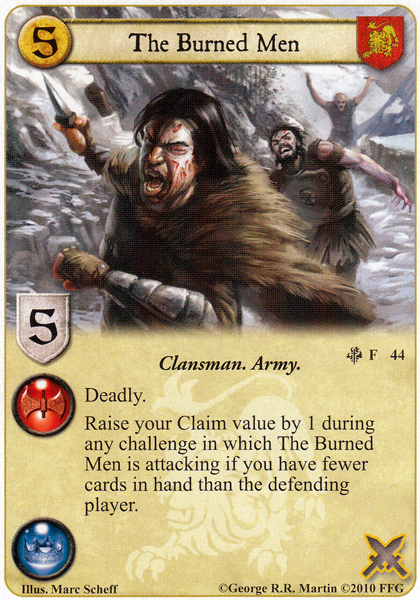
- The Burned Men (MotM) - raise claim (as long as you have fewer cards in hand)
- Ill-Begotten Spoils (ASoSilence) - another claim raiser (remember that these things can stack - put both into a challenge and you've raised claim by 2)
- Painted Dogs (IG) - effect is amped by having fewer cards
- Tribes of the Vale (LotR) - incredibly inexpensive army (as long as you can maintain fewer cards in hand)
- Tyrion's Enforcers (MotM)
This is a pretty obvious boon to this deck type due to Timett Son of Timett (MotM) because as long as he's in play, knelt Clansman cannot be killed. Couple that with Tyrion Lannister (LotR) (who can be saved by kneeling a Clansman) and you have what is the classic play on a Valar Morghulis (Core) turn. You kneel Timett to save Tyrion and you have, in effect, kept at least two characters in play.
Other cards that support this theme (some repeats from the above list... so you'll get dual-mileage from those):
- Tyrion's Thug (OSaS) - in this case, you want it on a Clansman so you can kneel it at the right moment
- Tyrion's Enforcers (MotM)
- Shagga Son of Dolf (DB)
- Rise of the Mountain Clans (MotM)
Some of you are already asking, "Where is The Inn at the Crossroads (LotR)?" Well, that's a good point. Not including it can mean you're missing out on a lot of gold, but the card is pretty expensive and, if you're struggling, it isn't directly helping your board position. This is really a "win-more" card. That said, if you have the slot available for it, gold is always nice.
The other tricky aspect of this deck type is the Intrigue challenge. This challenge is typically the Lannister go-to for the Challenge phase, but this can work against you in a Clansman deck as milling their hand has the unfortunate side effect of potentially making your hand being larger than theirs. Tread carefully with this challenge type.
Conclusion
Lannister can be an incredibly fun house to play and for some time, it was the go-to House for Jaime-style players using the Hyperkneel deck type to control the board. Lately, all the Houses have seen a variety of deck types appear during the tournaments in the past year. Lanni has fallen on some hard times, it seems, but there are some loyal players out there who have fielded some impressive decks.
Hopefully this article gives you some ideas on where you might go if you find yourself drawn to the House of Crimson and Gold. This article would have been impossible without the help of jmmcarthy, WWDrakey, amuk, and widowmaker93. WWDrakey and jmmcarthy pretty much wrote the Clansmen section.
As always - let me know in the comments if you think I'm totally off-base or if you have any additional ideas!
- jmccarthy, Amuk, Archrono and 8 others like this


11 Comments
Thanks for the help with this article! Great Review!
@n4m3l3ss0n3 I love Devious Intentions (BoRF) as a card. The ability to grant Stealth is always nice and giving Infamy and creating an uber-strong character is always worthy of a look. That said, I didn't include that specific card because it didn't seem to provide synergy with Clansmen in particular (over what it would do in any Lanni deck). Is there a synergy I missed? Please do tell!
@Seriously - glad you enjoyed it! Go Hyerperkneel... it's sooo much fun to mess with your opponent's plans.
It's another great card to play, if you can smell an upcoming Valar Morghulis. Thank's for mentioning it.
Very powerful, but tricky to use though. (By no means overpowered.)
Hehe. I'm so confused by this being a great play because of a potential Valar..
I took it to mean that Valar will screw it up so be sure you don't play it, use the infamy, and get valared. But I could've wrong.