
 Card Game DB

 Sign In
 Create Account
Welcome to Card Game DB
Register now to gain access to all of our features. Once registered and logged in, you will be able to create topics, post replies to existing threads, give reputation to your fellow members, get your own private messenger, post status updates, manage your profile and so much more. If you already have an account, login here - otherwise create an account for free today!
Register now to gain access to all of our features. Once registered and logged in, you will be able to create topics, post replies to existing threads, give reputation to your fellow members, get your own private messenger, post status updates, manage your profile and so much more. If you already have an account, login here - otherwise create an account for free today!
 2
2

Ours is the Fury - Monty Python's Black Knights
Oct 14 2013 05:05 AM |
WWDrakey
in Game of Thrones
Small Council Ours is the Fury WWDrakey Ours is the Fury - Monty Python’s Black Knights
Usually I tend to steer away from exact decklists in my Ours is the Fury articles, and rather concentrate on general deck construction principles, card knowledge, specific meta-choices, random rambling and all other sundry aspects of a more abstract approach.
There are a few reasons to this, really. Firstly, I don’t think that decklists that I have for decktypes that are already common knowledge (think Baratheon BS, from my last article) are optimized to rigorous enough Jaime-standards. Any exact list for such a build I could provide you with, would not be polished enough to provide value. I’m just not fond enough of optimizing common builds to put the effort in… now obscure and forgotten ones, those I enjoy enough to put in that crucial mileage of playtesting rigorously.
Additionally, exact decklists tend to carry with them quite a bit of meta-specific finetuning and personal preference, aspects which may not be completely portable to other environments. Going through core structures for decktypes just feels more generally useful - teaching a man to fish, instead of giving him a fish - if you will.
Now, I began that ramble with saying usually. Today, we’re at one of those rare exceptions. Why? Since I’ve never heard talk of such a deck anywhere, and having built it from scratch and tested it quite extensively… I actually feel it has some exceptional merit for a Baratheon build, while also being quite novel and interesting.
So, let’s forge ahead, and meet Monty Python’s Black Knights.
Monty Python’s Black Knights
"None shall pass. I move for no man."
"'Tis but a scratch. I've had worse." (with one hand cut off)
"Ohh... had enough eh? Tis' just a flesh wound." (with both lost)
"Right, I'll do you for that! I'm invincible." (with one leg left)
"All right, we'll call it a draw." (with no extremities remaining)
- Monty Python's Black Knight (wikipedia, youtube)
Theory:
Baratheon Knights has always been one of my very favorite decktypes, since they have probably the most stable method for fixing that inherent Baratheon weakness of always ending up top-decking with 2 cards a turn. Having to completely live and die with the luck of the draw is really never a good habit in any deck aimed at being even marginally competitive.
I’ve detailed the general structures of classic Knight Aggro decks in an earlier OitF, so let’s not go too far into that. Suffice it to say, that Baratheon Knight Aggro tends to be what I would call medium-Aggro. It churns out quite a bit of characters and can hit your locations somewhat, but unlike heavy-Aggro the characters don’t have as large a presence pound-for-pound (like Wildlings) nor does the deck exert enough claim pressure and targeted removal to completely clear your opponent’s board (like Greyjoy BS or Stark War-crest builds). Why does this sound familiar? Well, probably because most TLV decks ended up being medium-Aggro, just more efficient than Baratheon Knights!
Medium-Aggro decks tend to have specific strong and weak matchups. Strong ones would be, for example, location-reliant Control (most Burn and Kneel decks) and Aggro/Rush medleys (Siege of Winterfell etc.). Weaker ones would be Challenge-denial/Resource -based Control (GJ Choke, Martell KotHH) and heavy-Aggro (Wildlings, Black Sails).
Now, one of the Baratheon Knights inherent problems is the lack of efficient character removal, which tends to mean that problematic characters (like large armies such as The Viper’s Bannermen/Wildling Horde or fast powergainers like Cersei Lannister) can be extremely hard to deal with. Usually the only option there is to somehow try to work around them, and try to grab the game before your opponent can run you over - leading to many Baratheon Knight decks becoming Aggro/Rush. Not really an ideal solution, I’m afraid… especially with the frequency of problematic characters having increased steadily with the last few CP Cycles.
All of this is of course exasperated by the fact that Baratheon Knights usually just can’t run Valar Morghulis (the go-to solution to problem characters) efficiently - usually most of your work early game is aimed at trying to make their Valar less unfavorable for you, let alone running one yourself! It’s just one of those cases where it doesn’t fit your Agenda, cardpool or deck structure at all.
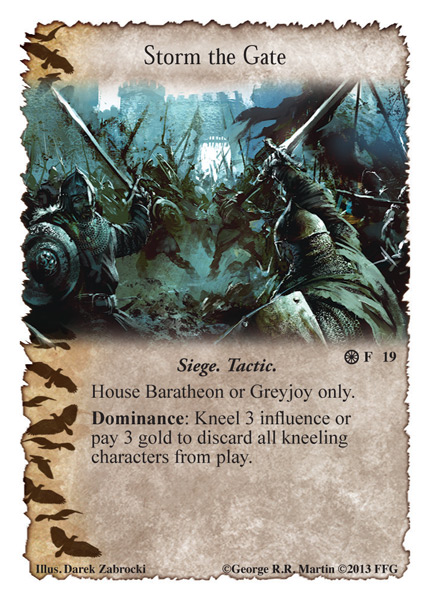
Enter the recently released card Storm the Gate, and suddenly that lack of reset-capability/removal has been completely answered… as long as you can build the deck to take advantage of it to it’s full extent. And that, is really what Monty Python’s Black Knights are all about. Never surrendering, headbutting your opponent even though both your hands are chopped off… tis’ but a scratch, after all. The end result is a far cry from Aggro, and functions mostly like a Control deck that pushes one-sided Resets, while supporting it with strong anti-Aggro capabilities.
Decklist:
House: House Baratheon (Core)
Agenda: Knights of the Realm (KotStorm)
Plots:
Rally Cry (TBG)
Wildfire Assault (Core)
Lineage and Legacy (KotStorm)
Men of Pride (THoBaW)
Loyalty Money Can Buy (QoD)
Melisandre's Scheme (RotK)
Threat from the East (QoD)
Characters (33):
3x Knight of the Rainwood (Core)
Ser Davos Seaworth (WLL)
Stannis Baratheon (VM)
Melisandre (RotO)
Marya Seaworth (KotStorm)
The Bastard of Nightsong (VM)
Ser Cortnay Penrose (KotStorm)
3x Asshai Initiate (KotStorm)
2x King's Champion (AE)
Willas Tyrell (VM)
Dale Seaworth (AToTT)
3x Vanguard Lancer (KotStorm)
3x Hedge Knight (KotStorm)
3x The Laughing Storm (GotC)
2x Arena Knight (RoW)
Margaery Tyrell (AToTT)
2x Stormlands Bastard (TIoR)
3x Royal Entourage (TTotH)
Events (13):
2x Obey the King (KotStorm)
3x Storm the Gate (TBG)
2x Direct Assault (KotStorm)
2x Westeros Bleeds (Core)
2x See who is Stronger (KotStorm)
2x Desperate Measures (TCC)
Locations:
3x Seat of Power (WotN)
Myr (AHM)
King Robert's Chambers (Core)
2x Kingswood Trail (CoS)
3x Stormlands Fiefdoms (Core)
3x Narrow Sea (Core)
Brightwater Keep (TBG)
Oakenshield Port (TPoL)
2x The Red Keep (TftRK)
Deck Structure:
Characters:
The core of the deck is quite a standard Knight deck, with 18 Knights total… however, the Knight choices themselves are all made to work with Storm the Gate (and the Westeros Bleeds being run for redundancy) - the un-discardable Knight of the Rainwood, the Vigilant Arena Knight who you can usually force to be standing during dominance, the duplicated Smuggler Davos, the influence-providing Vanguard Lancer… and even two King’s Champions thrown in to have able bodies that are immune to your own resets. And of course the ever-present Laughing Storm, so that your hand cannot be easily interrupted by intrigue challenges.
The rest of the character-base is filled with other discard-reset friendly cards (like Dale and the Royal Entourages), some power-gain (Melisandre), auto-includes (Brienne and Willas) and Asshai Initiates to provide some much-needed intrigue and efficient discard-engines to help build for even more card advantage via Melisandre’s Scheme.
Remember when I mentioned that anti-Aggro -thing? There’s nothing quite like the feeling of constantly recurring a Royal Entourage via Asshai Initiate only to fool it into play from your discard-pile with yet another Lord/Lady…
Events and attachments:
Events are really where a lot of the unique-aspects of this deck can be found. Now, the core are those two Westeros Bleeds and three Storm the Gates. Obey the King is there mostly to kneel renown-characters in order to bring them into the range of a Storm the Gates. Direct Assault helps with some of the Control-matchups, as well as providing a way to troubleshoot any arising influence-issues. Desperate Measures helps kickstart the discard-pile recursion engine beautifully, while See Who is Stronger makes The Laughing Storm become a complete nuisance… and often helps you regain Knight-based draw after an opponent’s Valar to boot.
There are also a few other events I tested with the deck, but ended scrapping in the final version - Snowed In (troubleshoots specific matchups and doubles for stopping duplicate/character-based saves during Bleeds/Storm the Gates) and Support of the Smith (helps with resource-issues). I’m still quite torn with those decisions, since both cards filled out weaknesses in the deck nicely. Depending on your meta, Obey the King can easily be replaced with one of these two, or you can just opt to trim it away to get closer to the magical 60 cards.
Since the deck runs quite a heavy set of events, attachments have completely been scrapped to make room.
Locations:
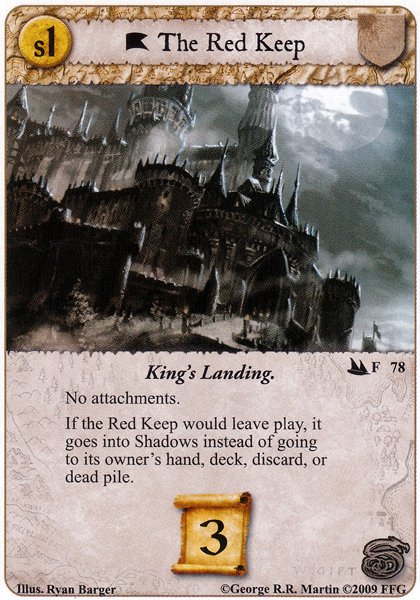
Well, firstly we have the influence-heavy resources, with two Red Keeps to help enable early Storm the Gates hits. Brightwater Keep functions as a substitute for The Laughing Storm when he is not around, while the two Kingswood Trails are absolute gold both for soft-controlling problem characters… and eventually setting them up for removal with Storm the Gates. Nice to see that card finally find a deck where it slots into naturally! The lone copy of Oakenshield Port is there to help provide the slow and ponderous deck with a faster win-condition, and does that job admirably.
Plots and the Restricted card:
Now, the original plotdeck in my first build was widely different. There were lots of 2-claim plus Melisandre’s Scheme and the restricted card was Negotiations at the Great Sept - a pretty basic Baratheon Aggro, if you will. The more I playtested it, the more I found that it just wasn’t what the deck wanted. The deck was ponderous - starting slow, then grabbing the game after a mid-game reset and gathering steam and recursion all the while.
The slow starts and Baratheon kicker-resources made Rallying Cry a natural fit. Lineage and Legacy and Loyalty Money can Buy both provided me with early-game plots that drop the speed of the game down - Lineage and Legacy is also a pretty fun plot to drop against a Siege that tries to go with that predictable Epics + Fear of Winter beginning. Wait till they realize what it does to their epic phases…
In the end there are only two plots remaining from that original plot deck - Melisandre’s Scheme and Men of Pride. After quite a bit of testing I also went and changed Negotiations at the Great Sept to something more old school - Threat from the East, to team-up with The Laughing Storm. There’s a lot of things that Threat does, that Negotiations just can’t match.
Firstly, it has high initiative, and this deck does like to control the pace of the game. Secondly, the deck can really use the gold - if anything it’s still a bit too cost-intensive due to the combination of 3-4g characters, high-influence events and good draw. Thirdly, it drawcaps your opponent without giving them cards and does so before even Golden Tooth Mines get to function. And finally, it’s one hell of a knock in the teeth against somebody going for a Negotiations with 1-2 cards in hand. Just choose to go first, make your plot be the first to happen and choose “discard first†-option...
Field Testing:
The deck was being built for a medium-sized Finnish Tourney, so I did quite a bit of field testing with it beforehand - mostly against other Small Council members (mainly Ire, but also JCWamma and OKTarg). The deck performed… disturbingly well. I think I lost 2-3 games (out of 10+) and those were primarily before I got the plots and events completely sorted out.
So, I took the deck to our Rains of Autumn Tourney (12 participant Joust, from 3 metas) and went 3-1 in the Swiss with it, losing my semi-final and ending up 3rd. The deck won against a Martell/Quentyn (running Venomous Blades, which are probably worse for this deck than The Viper’s Bannermen) and two Lannister/Kevan decks (one was more Aggro, the other more hyperkneel).
The loss in Swiss was to a HoD/Dragonpit deck that dominated the whole Tourney - I managed to remove The Dragonpit around Plot 4 with Rallying Cry, but due to my inauspicious start (mainly 1-2 STR characters) the power count was around 10-0, and the game ended around Plot 6 with something like 15-8. In general, the deck should match up okay against Burn, but Dragonpit might be the most difficult one - especially if the player piloting it knows what they’re doing - like in this case!
In the Semis I got a rematch against the more Aggro-based Lannister deck, got off an early Storm the Gates, forced his Valar… and suddenly started drawing the most random combinations of cards possible despite draw from Threat from the East/TLS and the Knight Agenda. These things just sometimes happen, that’s what makes cardgames interesting, really... The game saw me stall at 14 power for 3-4 turns, with the Lannister finally pushing a win on Round 8 with a second Cersei’s Scheme… partly because I held onto a King’s Champion over a Vanguard Lancer, only to lose on initiative against Cersei’s Scheme because of it. Lannister Aggro is usually a pretty good matchup for the deck, and you can probably blame that loss quite a bit on the pilot...
Afterwards I also casually tested the deck against a Baratheon Wildling from the Tourney, and a DC-style Quentyn, with good results - a first turn Threat from the East can do wonders for scrambling specific starting combos like Manning the City Walls with The Viper’s Bannermen...
- badash56, scantrell24, JCWamma and 8 others like this


12 Comments
Had to play pretty accurately, but won it.
Stalled for a few rounds by keeping a foothold on the board and shielding my hand (not trivial vs. 2-claims and Die By the Swords), simultaneously tying powergain down through Kingswood Trail (CoS) until I could pull off a Storm the Gate (TBG). That got rid of The Wildling Horde (TWH) (and renown uniques), I could repopulate through Melisandre's Scheme (RotK) and roll the game back. I think in the end the Wildling player wasn't able to get a proper board presence up anymore.
It's one of those matchups where you always need to remember an important thing about high-claim Aggro... if you can't beat them on the table (less STR, less claim) but have solutions in your deck for evening the game out later on, you should stall them as much as possible (remove unopposed, don't get power on your house for them to claim, tie down their renowns).
As mentioned in the article, the deck also has an additional trick built-in for Aggro that relies on Negotiations at the Great Sept (TPoL) for cards... they'll try to time Nego to when they're at 1-2 cards in hand, so if you follow that, you can often hit them with Threat from the East (QoD) (discard first) to empty their hand before it. The way Threat is currently worded, it can be nicely used to empty the hand of a player with 1-2 cards in hand, something that was definitely a factor in choosing it for this deck. Of course that particular trick is only really useful due to the fact that I'm running 3x TLS + Brightwater Keep to begin with.
Discard three first, I get that, they have 0 cards. But then they have to draw 3 more.
Nego should fire at the end of that shouldnt it?
I am probably missing something really simple... After I have my coffee maybe it will dawn on me.
text on discard first option:
Each player discards 3 random cards from
hand. Each player that discarded 3 cards draws
3 cards."
And as a player of that wildling deck WWDrakey mentioned, It is really annoying deck to play against with a aggro deck. Constant fear of Storm the Gates hinders you and still your deck needs to push challenges and try to strip opponents board/hand.
Most of them had to do with the events that you wrote above and I did notice that Obey the King (KotStorm) wasn't that usefull, at least not as much as Supported by the Smith (AJE), I've had economy problems and location control by a lot of my opponents.
An other thing I noticed was a lot of decks at the moment are running some sort of kneeling/standing element and it was getting hard for me to even get some characters to kneel for dominance, so I will definitely be picking up Snowed In (ARotD) to prevent anything from triggering during dominance.
Other than that, like I said .. really nice deck, puts your opponent into a sort of thinking they've probably never had to do ever before.
Yep, those would be the exact reasons why I was a bit troubled by my cuts. They were mainly meta-choices, and mostly relate to the field I was expecting. Unique stand locations can also a be a bit bothersome, which is one of the things that Rally Cry (TBG) tends to often get used for.
One of the benefits of the whole mechanic is that if your opponent is using their stand to keep a large percentage of their board up, that means a huge drop in the STR/characters that are actually participating in challenges - giving you a clear board advantage.
It's a fun mental trap really - the more cautiously they play, the more you can push ahead with challenges, while the more aggressively they play the more damage they're risking from a reset event.
Am I right assuming that you are thinking of using Snowed In (ARotD), in order to prevent various saves (including dupes) when it comes to discarding characters with Storm the Gate (TBG) or Westeros Bleeds (Core) during dominance?
And if that's right that would mean Snowed In blocks all "gained" character effects? And the order during dominance would be:
-Event (Snowed In) ==> possible cancels or w/e
-Event (Storm the Gates/West Bleeds)==> possible cancels or w/e
-Finally dominance power gains?
Thanks in advance for answering by the way
Actually, the dominance action window is only after the actual dominance count and powergain.
So it's more like:
- Shadows (possibility to bring out Red Keep if you need it for the influence, I often keep it in Shadows until the exact moment I need it, so that it doesn't get hit by a stray Support of the Kingdom (Core))
- Dominance Count
- Actions
(first player has first action)
- As your first action, play Snowed In -> cancels etc.
(opponent's action in-between)
- As your second action, push the reset (Bleeds/Storm the Gate) -> cancels etc.
And yes, duplicate saves actually give the character a Response: ability, which means that they can be stopped by cards like The Iron Throne (LotR) or Snowed In (ARotD). Oh, and of course gained abilities are also hampered by Snowed In.
Other ways to use Snowed In are to play it at an opportune point during Challenges (during a challenge with a House Clegane Brigands (AToTT) or Wintertime Marauders (ACoS), for example). You can even sometimes play it pre-plot when you have board dominance (especially against GJ) in order to stop their character-based saves in case they Valar... often meaning that you can force them to hold onto the Valar for one more turn, which will allow you to push for more power in the meanwhile.
Against a kneel-heavy Lannister with Castellans and Enemy Informers it's also quite good to play at the beginning of Marshalling. And interestingly, that won't stop you from getting Royal Entourages into play, since Snowed In works on character abilities, and effects printed on characters are only abilities if the character in question is already in play.