
 Card Game DB

 Sign In
 Create Account
Welcome to Card Game DB
Register now to gain access to all of our features. Once registered and logged in, you will be able to create topics, post replies to existing threads, give reputation to your fellow members, get your own private messenger, post status updates, manage your profile and so much more. If you already have an account, login here - otherwise create an account for free today!
Register now to gain access to all of our features. Once registered and logged in, you will be able to create topics, post replies to existing threads, give reputation to your fellow members, get your own private messenger, post status updates, manage your profile and so much more. If you already have an account, login here - otherwise create an account for free today!
 1
1

Taking the fun out of everything with the binomial coefficient
Jun 28 2012 01:00 PM |
adamnation
in Game of Thrones
Small Council adamnation Abstract: In some cases, the probability for achieving a given card combination in A Game of Thrones card game can be calculated using combinatorics. In this work, the probability of achieving a general combo prior to the first challenge phase is calculated, depending on the number of cards required for the combo and the number of occurrences of each card in the deck. Further, a specific card combination is investigated.
Introduction
In discussions of combos for A Game of Thrones (AGOT), often there are comments like “in testing, I’ve drawn this combo seven times out of tenâ€. This type of nonrigorous testing is silly, because in many cases the combo probability is readily calculable. Here, the probability of achieving a combo is calculated given the number of distinct cards necessary and the number of each card present in a deck. First, the general case is examined, wherein some number of cards N is required to achieve a combo. Then a specific combo is investigated. The results are presented first, followed by the theory for calculating card-drawing probabilities.
The scope of this article is limited to combos that occur prior to the first challenge phase, before random card discards make everything not readily calculable. Thus, the impact of mulligans and a 2-card draw in the draw phase are taken into account. Obviously, opponent actions like Threat from the East can reduce combo odds, and other effects can improve combo odds, like extra card draw from agendas. For the sake of simplicity these effects are ignored.
Results
General N-card combos
The probability of drawing a given number of specific cards when they each occur once, twice, or thrice in a deck is given in Table 1. Edit: These numbers depend on the number of cards played during setup, so a setup of three cards is assumed. It is further assumed that the first drawn hand is "all-or-nothing"; the player mulligans if he or she does not achieve the full combo.
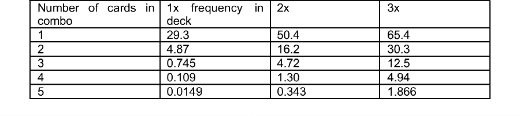
Table 1. Probability (%) of achieving a card combo in setup+first draw phase, given the number of cards in the combo and the frequency of each card in the deck.
For example, there is a 30.3% chance of achieving the Laughing Storm/Val combo in the first turn if there are three copies of each in a deck. Despite reservations stated above against discussing particular plot choices, it is important to point out that obviously these odds change if the first plot chosen is Summoning Season. Then there is a 60.8% chance to draw one of the necessary characters after setup, and, with proper character selection, 100% certainty of summoning the other. (Note that this 60.8% figure is a drop from 65.4%, because the latter number includes the draw phase. Those extra two cards can not be counted on in this case, because the summoning target must be known during the plot phase.)
Rule by Decree + Threat from the East Discard combo
In this combo, the Laughing Storm and a Maester are played during setup. Prior to the first plot, Citadel Law is played in order to reveal Rule by Decree, causing an opponent to discard down to four cards. Finally, Threat from the East is revealed as the “real†plot in order to discard an additional three cards from the opponent’s hand.
The required pieces of this combo are the Laughing Storm, Citadel Law, and a Maester that costs two or less. All of the pieces must be in place after setup. A deck can have up to three copies of TLS and Citadel Law, and there are 15 neutral or Baratheon Maesters currently available of cost two or less. In Fig. 1, the probability of pulling off this combo is plotted as a function of the number of qualifying Maesters included in the deck. Curves are plotted for all possible numbers of The Laughing Storm and Citadel Law included in the deck. Fig. 1 shows that this combo has a greater than 15% chance of success only if the deck contains 3 copies each of The Laughing Storm and Citadel Law. Edited to include the probability of drawing only TLS and a Maester, setting them up with one other card for a total of 3, and then drawing Citadel Law when refilling hand.
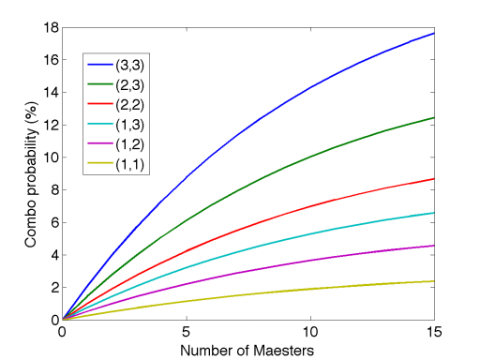
Fig. 1. Probability of discarding 6 of opponent’s cards in first plot phase as a function of the number of included Maesters. The ordered pairs in the legend refer to the numbers of The Laughing Storm and Citadel Law included in the deck, e.g. (2,3) implies that there are 2 TLS and 3 Citadel Laws.
Future Work
Further combos will be investigated in later articles, including first turn marshalling wins and discarding an opponent's deck. Additionally, the average number of cards placed during setup will be calculated as a function of the number of cards of each cost in the deck. Additional article suggestions should be left in the comments.
Methods
Counting is at the heart of card drawing probability theory. The probability of drawing a hand is the number of favorable hands divided by the number of possible hands. The trick, then, is counting the number of favorable and possible hands.
Number of possible hands
First, consider the number of possible hands. As an example, consider if the AGOT rules changed such that an initial hand consisted of only two cards. Then there are 1770 possible hands for a 60-card deck. There are 60 possible ways to draw the first card and 59 possibilities for the second, so there are 60x59 = 3540 different draw orderings. However, drawing card A and then card B yields the same hand as drawing B then A, so the total number of unique possible hands is 60x59/2 = 1770.
Next consider the case of a three-card hand. Again, there are 60 possibilities for the first card, card A. After the first card is drawn, the situation is the same as the two-card case, but with 59 total cards remaining. So there are 59x58/2 ways to draw card B and card C to achieve a three-card hand. Thus, there are 60x59x58/2 ways to first draw card A, and then draw cards B and C in any order. But each of those hands is the same as a hand in which B or C was drawn first. Therefore this result must be divided by three. The total number of possible three-card hands is 60x59x58/3/2 = 34,220.
There is a pattern emerging; the number of possible ways P to draw a k-card hand out of an n-card deck is
 (1)
(1)where the factorial n! = n(n-1)(n-2)...1. Equation (1) is known as the binomial coefficient, and in this work will be expressed in the notation P(n,k) or the parenthetical notation of (1). The latter is not to be confused with vector notation. Using (1), there are 386 million possible seven-card hands from a 60-card deck.
Number of favorable hands
All of the favorable hands contain some number of all of the desired cards. Again, an example: assume that one The Laughing Storm is desired, and that TLS occurs once in a deck. A favorable hand consists of one TLS and six other cards, so the number of favorable hands is equal to the number of ways to draw six cards to fill up the rest of the hand. Again, this is given by the binomial coefficient: P(59,6) = 45 million favorable hands contain TLS.
If there are three TLS in the deck, then a favorable hand has one, two, or three TLS and six, five, or four other cards. To find the number of hands with a given number of TLS, the number of ways to draw that many TLS must be multiplied by the number of ways to fill up the rest of the hand. Then each of these terms must be added to count the total number of favorable hands. This is summarized in Table 2.
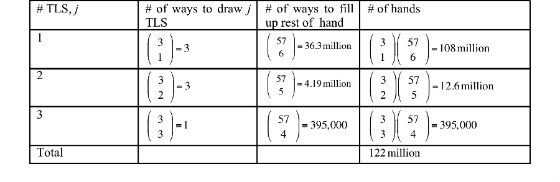
Table 2. Favorable hand calculation when seeking one card that occurs three times in a deck.
If more than one type of card is being sought, then each term must be multiplied by another binomial coefficient representing the number of ways to draw the additional card. If the number of cards sought is m, and there are N1 copies of card 1, N2 copies of card 2, and so on, then each term is of the form
 (2)
(2)where j1 is the number of cards of type 1 in this particular hand. These terms all must be added for every possible combination of j1, j2,…,jm that makes a valid favorable hand. Altogether, the number of favorable hands Q containing m specific cards, that each occur N1, N2, …, Nm times, when drawing a seven-card hand from a 60-card deck, is given by
 (3)
(3)where the sums terminate at J1, J2, …, Jm, the minimum of (the maximum number of cards of that type in the deck, or the number of card slots remaining such that all sought cards fit in the hand). For example, if a favorable hand requires two separate cards, which each occur three times in the deck, then card 1 can be present in a favorable hand up to J1 = 3 times. If six separate cards are sought, then only two card slots are available in a favorable hand for card 1.
Mulligans and first draw phase
The probability of not achieving the desired cards in the first attempt is 1-Q(m,60,7)/P, where P is the total number of possible hands, given by (1). The probability of not achieving the desired cards in two attempts is (1-Q(m,60,7)/P)2. Thus, the probability of drawing the desired hand, taking into account mulligans, is 1-(1-Q/P)2. The probability of the desired hand, including mulligans, a three-card setup, and the first draw phase, is 1-(1-Q(m,60,7)/P)(1-Q(m,60,12)/P).
- Amuk, Rave, Zaidkw and 4 others like this


20 Comments
Since this is worded like an article, I'll read it like a referee. I apologize in advance.
Notes:
- Your text regarding Summoning Season feels a bit funny, since you're completely disregarding the draw after the Plot-phase. There's still the off chance, that you can use Summoning Season to search for one component, and then try your luck at drawing the other one. For the Val/TLS combow, with your assumption of a 3 card setup, that would leave you with something close to a 6% chance for each draw to be the second card... (ending up at something like 12% from 1-46/49*45/49) for the chance of drawing at least one copy of the other one (assuming the 3x/3x). [Cigarette-pack calculation, sorry if I made a mistake somewhere]
- You've left out the Apprentice Collar (which has Setup) from your calculation, and this may have an effect, since it will easily both push setups into higher numbers and increase your Maester count.
- Especially with Apprentice Collar, you could add in Val to help you dig deeper during the pre-plot phase for Citadel Custom. (By setting up Val, Collar on Val, TLS) This would give a slight boost for chances on getting the combo off.
- Then the big one: The Maester's Path (which will thin your deck beforehand) is completely umentioned in your practical application of the theory, even though it forms a crucial point of the said combo deck. Since you don't mention the number of cards on the Agenda as another choice that affects he probabilities, you're approaching this problem either starting from a 60 card deck, or with all 12 chains on the Agenda? If you're starting from 60, then your probabilities will probably be too small, and should be evaluated by reducing the deck size proportionately. The choice and your explanations for it would also need to be mentioned in the article at some point.
Otherwise, I heartily endorse this for publication.
You sir, are the best. Not from the UK, but love Numberwang!
Obara Sand (TWoW)?