
 Card Game DB

 Sign In
 Create Account
Welcome to Card Game DB
Register now to gain access to all of our features. Once registered and logged in, you will be able to create topics, post replies to existing threads, give reputation to your fellow members, get your own private messenger, post status updates, manage your profile and so much more. If you already have an account, login here - otherwise create an account for free today!
Register now to gain access to all of our features. Once registered and logged in, you will be able to create topics, post replies to existing threads, give reputation to your fellow members, get your own private messenger, post status updates, manage your profile and so much more. If you already have an account, login here - otherwise create an account for free today!
 2
2

The Long Voyage
Apr 05 2013 04:05 PM |
istaril
in Game of Thrones
The Long Voyage istaril In Martin's books, a long sea voyage is invariably a bad idea. Poor Rodrik Cassel lost his prized whiskers to his trip, and even the seaworthy Iron Fleet can't seem to make it across the Narrow Sea without taking massive losses...
The Long Voyage (TPoL)
This new agenda has resulted in a fair bit of discussion. People are re-examining the reasons to keep decks small, and the cost of decks above 60 cards – and if a card causes people to at least challenge their preconceptions, I'd say it's a win from a design stand point. But is it playable?
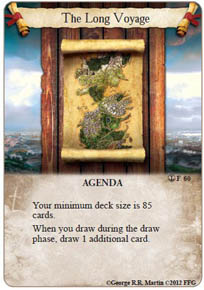
You get to draw an additional card every round regardless of board state. This sets it apart from the other card-advantage agendas Knight of the Realm and Kings of Summer, not to mention the latter is restricted. Drawing an additional card every draw phase is great. The payoff is even greater in decks that have trouble getting draw elsewhere – an increase from 2 to 3 cards a turn increases your options by half.
The Cost:
1. You have to run an agenda and can't run another agenda. As these costs are the same for all agendas, we'll avoid rehashing this particular downside.
2. Your deck must be at least 85 cards in size. The chance of drawing any specific card decreases, and you risk heavily diluting your deck's theme, and your resource curve suffers from the lack of redundancy.
What does this actually mean in terms of efficiency?
First, we'll compare the cumulative chance of drawing any necessary card present in 3 copies. We'll assume a 4 card setup for both decks, and that the TLV deck is always drawing one more card per turn than the non-TLV deck. The first point (1) is your setup, the second is after your redraw and your turn 1 draw (2), and each subsequent point is after the following draw phase (ending at turn 7, point 8).
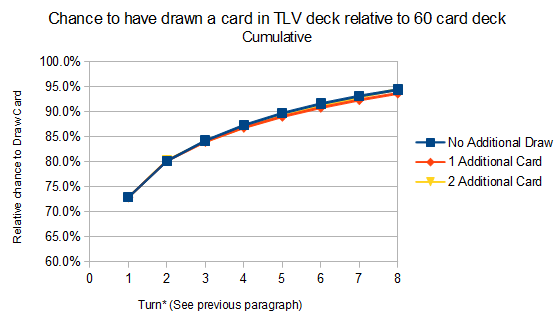
The TLV deck is always less likely to draw any specific card, despite drawing one more card. This tendency decreases as the game goes on, starting from ~25% worse in your setup hand and improving each turn thereafter. By plot 7, the TLV deck is only ~5% less likely to draw any given card. These numbers don't change by the addition of draw to both decks.
Now let's take a look at the chance of drawing a specifically needed card in any given draw phase, rather than the cumulative chance of having drawn said card previously. Will you top-deck into that Red Vengeance you really need?
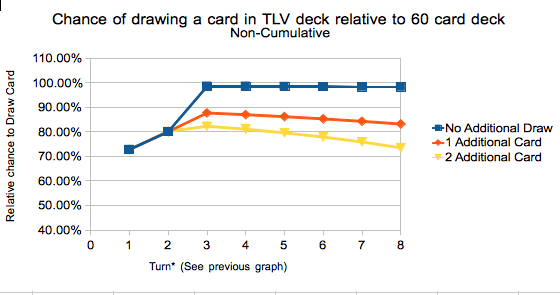
Here the difference is much less pronounced. The advantage is once again with the No-Agenda deck, although once you discount the ~30% advantage no agenda has in setup, the difference is around 2% provided neither deck is drawing additional cards. If you add draw engines, you greatly favor a 60 card deck.
Trip Planning; optimizing your deck for The Long Voyage:
Resources: Most decks are already using the majority of the resource options available to them. To maintain the correct ratio of resource producers in the deck, you need to consider additional choices, most of which are Limited. If you're not running Lanni, who can easily add non-limited gold producers to close the gap, you may have to consider non-limited alternatives (Myrish Villa (QoD), Streets of Hellholt (TIoR), Ambitious Oarsman (RoR), Kingdom of Shadows (KotS)), or keep a very close eye on the gold from your plots. How many Limited cards can you afford? Have a look:
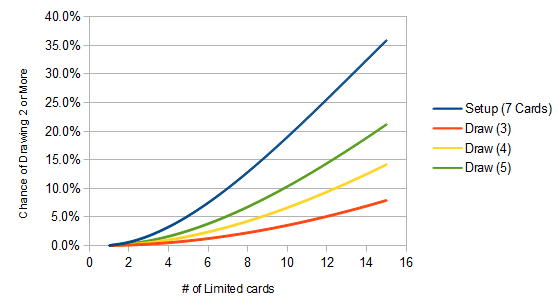
Poor Setups: Very few houses have enough redundancy in the low-cost range of setup cards to allow a larger deck to have comparable setups. Any card lost in setup is directly opposing the benefit the agenda grants, although it's worth noting that the value of a card in setup is lower in a TLV deck, as the chance to redraw into a specific card is lower.
Search: Search essentially bypasses the inconvenience of having a large deck and can effectively increase the number of “desired†cards (Wolf Dreams (LoW), Dance With Dragons (Core)), or use your large deck as a toolbox (To Be a Wolf (SB)) or simply find the right character for the job (Aeron Damphair (KotS), No Use For Grief (DB), all the Heralds, Muster (Core), Bound by the Light (DB), Yoren's Task (BtW), Jeyne Westerling (ASoS)). While the absolute value of search is no better in an 85 card deck than a 60 card deck, the value relative to your chance of drawing into a needed card is much better.
Redundancy: This is too big a concept to go into great detail, but redundancy offsets all the costs seen in the graphs. If I could include more copies of a card, then I could match the % chance to draw it from a smaller deck (There's a secondary effect which is that it increases the chance of drawing more than one of said card, not always a good thing). Since I can't do that, I have to include cards that are functionally equivalent – for instance a
Carrion Bird (TWoW), Direwolf Pup (Core), Shaggydog (Core), and The Hound (PotS) might all fill the same niche in my deck.
So what does the ideal candidate for The Long Voyage have? Poor draw, little dependency on setups, longer games and has a theme with high redundancy (or a lot of search). If you've got 3/4 of these, it's probably worth trying a Long Voyage... and remember, you're gonna kick ass against Mill.
Some initial candidates that come to mind include a Stark Toolbox/search deck, a Greyjoy choke deck, a Targaryen Dothraki deck, a Targ burn deck, or a Lanni Clannsmen deck.
Because an 85 card deck changes deck building quite drastically, I think it'll be a while before we can really judge the agenda properly. The math doesn't reveal any reason why the deck can't be a contender... so as usual, it's up the finest deckbuilders to settle the matter!
- zordren, Danigral, darknoj and 5 others like this


19 Comments
The chance of drawing a specific card my be reduced in TLV but that can be compensated for by using negotiations at the great sept, the princes plans or unbent, unbowed, unbroken to add a large number of new cards into your hand without worrying about draw cap.
I consider this a more newbie friendly agenda, no frills draw and not having to struggle to cut down to 60 cards will help a lot of new players find their feet. It also doesn't work well as with combos and may encourage simpler deck designs.
Other card advantage agendas like kings of summer and black sails tend to favour more shagga builds and each have weaknesses, these could probably outperform TLV in the hands of a more experienced player.
@erocklawell : I'm delighted to hear that! It's high praise, and I hope that if I take up the pen again it'll appeal to you as much.
@Mulletcheese : Again, it's worth noting that effects like U,U,U or Negotiations can help you sift through a larger deck for specific card and can help mitigate the effect of deck dilution, they will always be less efficient than the same cards played in a 60 card deck. In fact, the more you "Draw" (Reveal, Replace), the more efficient your 60 card deck would have been relative to your TLV deck, as seen by the second graph (because you're searching through a deck that's getting proportionately smaller faster, with the exception of Negotiations). That said, self-milling for Bara or Martell, anti-mill tech, and being able to put in toolbox 1-ofs and be less likely to draw them when you don't need them are all advantages of the larger deck.
For a complete look at the rules discussion surrounding this agenda, check out http://www.fantasyfl...=798524&efpag=0
Second, I am wondering what the consensus is regarding event choices in a deck like this? Like, would it even make sense to run cards like Finger Dance or Paper Shield, since they are situational and you can't guarantee you can get to them when you need them (I suppose the same could be said for in a 60 card deck), or more solid, you can play them any time you draw them events (examples escape me at the moment)?
If we look at the situations depicted in graphs 1 & 2, we can fairly closely mimic the chance of drawing a 3 copy Finger Dance in setup by including 5 "Cancels" in 85 cards, but if we're more worried about drawing into it post-setup, 4 copies are a better mimic.
I may see if I can design a more user-friendly version of my spreadsheet to easily answer questions like this one, as I suspect they'll come up often!
One of the things not really examined in the article is a thing about AGoT itself, the dependency to draw that 1 card in your deck is very low generally speaking. Because there are no instant win combos in the game most decks revolve around a level of synergy or simply including as many efficient cards as they can into their 60 card deck.
If you struggle to find space for a good character in a cost bracket, or a good location or event that is just not quite as awesome against your suspected field as another, then this is the agenda to try. If you look at the card ratings and reviews you'll frequently get things like, "This event is great, but Martell/Lannister already has so many great events what do you take out?" Sub the house and card type for the ones relevant to you. The answer is you take nothing out. Just grab all the best cards that do the stuff you want and the metagame choices you feel you need. Then count them. Where are you at? If you are at 50 or more cards before you even have dealt with resources this is an agenda you should consider.