
 Card Game DB

 Sign In
 Create Account
Welcome to Card Game DB
Register now to gain access to all of our features. Once registered and logged in, you will be able to create topics, post replies to existing threads, give reputation to your fellow members, get your own private messenger, post status updates, manage your profile and so much more. If you already have an account, login here - otherwise create an account for free today!
Register now to gain access to all of our features. Once registered and logged in, you will be able to create topics, post replies to existing threads, give reputation to your fellow members, get your own private messenger, post status updates, manage your profile and so much more. If you already have an account, login here - otherwise create an account for free today!
 0
0

The Things I Do For Win - Draw and Jaime C-c-c-c-combo
Jan 18 2013 06:00 PM |
clu
in Game of Thrones
Small Council The Things I Do For Win clu The Things I Do for Win- Draw and Jaime C-c-c-c-combo
I rarely play combo at tournaments, but when I do, I play an obscene amount of tutor and draw effects. There are different types of combo out there that can give you an advantage during a game. Some are as simple as Ghaston Grey with nobles to the more sublime Laughing Storm, maester, reveal a new plot card into Threat from the East. No matter the reason, supplementing your deck with draw will get you there faster.
The Importance of Draw
Drawing cards is good, but not necessary in every deck. An optimally created deck will draw gas every turn. For us mere mortals who need help, adding a dash of draw can mask cards that are situational or just plain bad. This is important when you draw resources late in a game. At that point they are dead cards not mattering during the game at all.
In my last article I introduced a couple ideas. The framework I’m going to bring back is looking at how many cards do you draw during an “average†game. Assumption number one, you are not playing Knights of the Hollow Hill or House of Dreams. Assumption two, a deck will have four cards during setup. Assumption three, most games will be decided by turn five. Assumption final, the deck is 60 cards. Using those parameters the following turns will go like this;
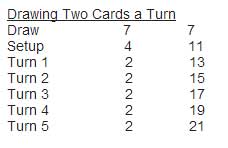
At the end of turn five you have drawn a total of 21 cards or 35 percent of the deck. Just to show the difference let’s imagine a single extra card per turn;
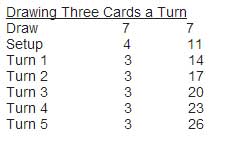
At the end of turn five with the extra draw you have mitted 26 cards or 43 percent of the deck. That is a total of five cards, and it really doesn’t matter if you got the five cards in one turn or a card a turn. A couple agendas can do this for you in Knights of the Realm, Kings of Summer, and I would be remiss to not mention one of my favorites; Seal of the Crown. Here is the White Cloak Arsenal for draw;
The Whitecloak Arsenal - Draw, Fistful of Cardboard
Is that enough to draw your combo?
How Many Cards is Too Much for Your Combo?
Short answer, it doesn’t matter in a vacuum.
A combo implies several cards need to be in your hand before you can execute the finishing blow. How many cards do you need to draw before the end is near for your opponent? Let’s say you have a three card combo and only three different cards can complete what you are trying to do, that means one in every 20 cards of your deck contains each of the components. Looking at the above draw two cards a turn schematic you are only guaranteed the combo at turn five assuming perfect distribution.
For you math folk, a two, three, or even seven card combo won’t be realized until turn five. It doesn’t matter how many cards comprise the ultimate doom. Each combo card represents three pieces of cardboard in your deck. That’s three in 60 or five percent of the deck. If you break down three in 60 it’s one in 20 cards. You have to draw 20 cards on average before you actualize your plan. Ugh, unless the combo ends the game, the game has already been decided.
I have a Google Spreadsheet that breaks down the real math into percentages. It was originally created for the resource article talking about what the odds were of drawing a single card type IF you haven't drawn it as of yet. The same math should transfer over to combo as well. The percentages are going to be much more depressing because it is unlikely you can get 9 cards that replicate the same effect you want AND you have to draw a second or third card as well. The math is intriguing and may make folks never want to run combo again without all the pieces being tutorable at a major event.
Two folks who are smarter than me* put this together as an example;
Google Spreadsheet Income Probability
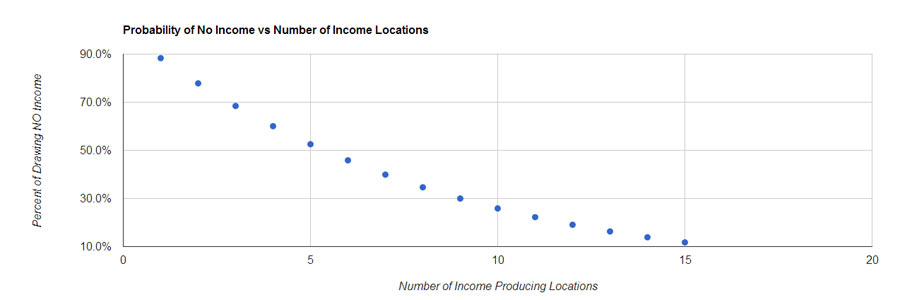
This chart was originally put together for the resource article. I realized it has more meaning in a combo deck. It measures what the odds of you NOT drawing a card for every card you have drawn.
*Thanks to But-R-Bumps and MeatlaofX for making this happen. I will leave it up to you to defend what you have done!
And, unfortunately we don't play in a vacuum...
Just because you CAN draw the combo doesn't mean it will happen; characters die, locations get blown up, and events are discarded to intrigue challenges. And this all based on perfect distribution. You shouldn't count on playing a combo before turn five unless you have supplemental draw, tutor effects, and defensive measures to protect your cards.
Imagine you lose an intrigue challenge every turn with claim one, not a crazy idea. Normally a hand would be packed with 21 cards, now subtract five of those cards. That's just under 25 percent of your hand size, hope none of those were part of your master plan. Combo isn't undoable. Just know what you are getting yourself into.
Redundancy and Math
Granted the assumption that the game will be over is by turn five is just that, an assumption. The earlier you draw game ending scenarios the better. To up your odds in drawing the combo check out this article by Kennon, pay particular attention to Redundancy through Replication.
When looking at the combination effects try to find other cards that replicate them. While an inferior card looks mopey at first glance because of the lack of efficiency it can be a rock star. Ignore the cost for right now, solely look for duplicating effects. If you can find another card to mimic similar effects then you are doubling you chance to draw the combo.
If three out of 60 equaling five percent is reasonable, then six out of 60 equaling ten percent is fantastic. It also means one out of ten cards you draw is part of your master plan. Looking at the Drawing Two Cards a Turn schematic you will have drawn it by turn one! Now we are cooking with the Hound.
If you can duplicate each of your combo effects by at least one other card and put three of each of them in your deck, after turn one it is possible to draw a ten card combo. Granted, you may not have the resources to pay for them
Be Like Bronn - Draw First, Thin to Win First, and Fight Dirty
Some effects cannot be repeated and you will be forced to rely on draw to get a win. It’s a time honored tradition for the combo player. Looking at the Drawing three cards a turn schematic you will hit the combo by turn three. Turn three is better than turn five. If you draw more than that, the sooner you get your lock in place. If you take it one step further and draw two additional cards a turn it quickens the pace to;
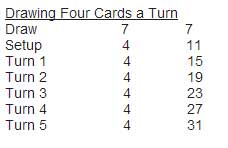
Oh, it still takes until turn three to draw 20 cards and the combo. Even after drawing six more cards over the three turn span you won’t statistically get to your combo faster. Some draw is good, overkill is meaningless.
To supplement drawing into your combo, some of the cards may be searched. There is nothing more satisfying than seeing a combination of cards that you can instantly assemble. It may not be fair but dying with honor isn’t something we’re interested in doing.
Tutoring does two things; firstly you get the card you are looking for. A card that can’t duplicate the effect but can search out the effect is just as good as running a second effect card. You just bumped up your previous three cards to six, that’s turn one territory.
Secondly, you thin the deck, the fewer cards in the deck; the more apt you are to draw the cards you want. The phrase “thin to win†is real.
Putting It All Together
I have long disparaged dragon decks until I was forced to rescore the Meerenese Fighting Pit. I have combined every possible combination of card advantage, beginning with a smaller deck, draw, and tutor effects. While not a world beater, it definitely exemplifies meeting my combo conditions early and often.
Targ Maester Dragon Shotgun


4 Comments
If each draw effect garners one or two cards it accelerates into more card draw. From the Be Like Bronn section, we see that drawing more than three cards a turn is just as valuable as four cards to get the combo peices by turn three.
Explained simply (ignoring the spreadsheet) 12 cards of draw is 1 in 5 cards. Means you should have two cards of draw during setup. This will power you into three drawing cards starting with Turn One with perfect distribution.
Nine cards is 1 out of 7. Means you will have one card after setup. You won't get to the second draw card until turn 2. After that is gets sketchy only pulling into a draw card every third turn.
In a perfect distribution world we'd go 10 draw cards. It will net you a draw card for the first four turns to find the sweet spot.
An interesting thing will be applying it to a thinned down Baratheon Maester deck I've been playing with. (Since a few pieces of the combo(s) are on the agenda/tutored with At the Gates (GotC), redundancy seems to be key for the remaining pieces.)
I think "tutoring" (especially through things that don't give your opponent cards,) is one of the fairly under-utilized tools we have a fair bit of access to.
Herald of the Stag (SB) etc. for characters is a pretty safe way of grabbing exactly the character you need for a combo. (As long as you have a draw you can trigger right away, and play it/keep it from being discarded from your hand that is.)
To get quality, you often sacrifice quantity. For my part, take your time and keep up the good work Clu. I always look forward to your articles.