
 Card Game DB

 Sign In
 Create Account
Welcome to Card Game DB
Register now to gain access to all of our features. Once registered and logged in, you will be able to create topics, post replies to existing threads, give reputation to your fellow members, get your own private messenger, post status updates, manage your profile and so much more. If you already have an account, login here - otherwise create an account for free today!
Register now to gain access to all of our features. Once registered and logged in, you will be able to create topics, post replies to existing threads, give reputation to your fellow members, get your own private messenger, post status updates, manage your profile and so much more. If you already have an account, login here - otherwise create an account for free today!
 0
0


The Things I Do For Win - Icon Counting (Part 1)
Sep 07 2012 04:44 PM |
clu
in Game of Thrones
Small Council Things I Do For Win clu Rhoynar Emissary has been causing a stir in the community about its relative usefulness. To combat the challenge phase shenanigans every deck should be running a decent spread of icons and players should understand the order of challenges. These are basic rules for every deck.
In There Are No Decks Like Me I outlined why having a decent spread of icons is important to winning games here: Brett Zeilers Moonboy Classic 1st Place Deck
I’ll reproduce the general idea here:
The MIP Test
I like to check icons to make sure a deck is well balanced or at least find out the shortcomings. I take the characters and divide them into seven piles, these form a straight line left to right:
- Military Icon
- Military and Intrigue Icon
- Intrigue Icon
- Intrigue and Power Icon
- Power Icon
Here’s a more visual representation:
MIP
MP
M MI I IP P
More Options: More Wins
Each character has the possibility of being a tri-con, meaning they can participate in every challenge. I tend to harp on this during every article but it bears repeating; THE MORE OPTIONS YOU HAVE LEADS TO WINNING MORE GAMES. I’m thinking about getting this as a tattoo.
Let’s say each player has three characters on the table with all the same strength. One team is mono-cons from each challenge type. The other group is packing all three. The tri-con group can win every challenge or defend one of the challenges and still win which challenge type they want. The flexibility is being able to stop whatever I want and then attack which aspect I want. Pay attention during games where you begrudgingly let challenges through because you want to counter attack. You probably don’t have enough of the icon you want.
Let’s say an average deck contains 40 characters, or 66 percent of the deck. Supposing a three card flop, a deck will draw 12 cards going into Marshalling Phase on turn one. Of those 12 cards 7.92, or 8 rounding up, are characters. The restriction of the amount of gold won’t allow you to play every single one. Aside from gold costs you should pay attention to your icon spread in play. By knowing what icons you have in the deck you should have a good idea of what kind of challenges you have available.
A rough minimum MIP goal count is 30, 20, and 10 or 75, 50, and 25 percent of every character your draw. The percents for each card you draw are 50, 33, and 16. I will assume you are a good Jaime card player and only cram 60 cards into a deck.
The high number is your primary challenge type, then secondary, and finally tertiary. I keep using numbers to demonstrate what the probability is to draw what icon from your deck. Knowing your icon count let’s you make informed choices about who to kill on the board, whether to hold onto an event, and other synergies to pursue during deck building.
To give you an idea of which decks may fit your scheme the following list is the most numerous icon availability for every house:
Baratheon*
- Power
- Military
- Intrigue
- Military
- Power
- Intrigue
- Intrigue
- Military
- Power
- Intrigue
- Military
- Power
- Military
- Power
- Intrigue
- Military
- Power
- Intrigue
Looking at Brett’s Deck as an Example
Even if you are piloting a War of the Five Kings deck you have pack intrigue and power icons. Power icons will come with the Stark territory but nabbing intrigue takes a little more work, kinda.
file:///C:/Users/JERODL%7E1/AppData/Local/Temp/msohtml1/19/clip_image002.jpgHere is an example from the same article and exemplifies what kind of knowledge you can pull from your deck after simply counting your icons. Here’s what Brett’s deck contains:
- 32 Military Icons
- 12 Intrigue Icons
- 29 Power Icons
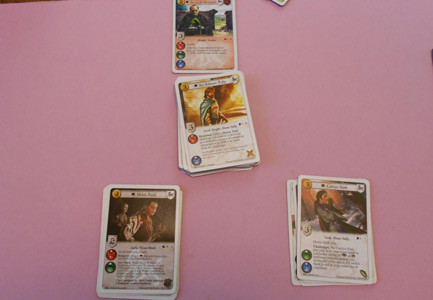
Notice in the picture there are three gaps in the lower card line? There are no single icon characters. Brett has ignored them and so should you unless you have a good reason. It stands to reason that a character with two icons is twice as useful during the game then a character with one. A tri-con is the holy grail but those are far and few in between.
Stay Tuned Next Week
Part II builds off of the icon availability established in Part I. It examines how correct challenge order during the course of a game can lead to more Ws.
- jackmerridew, DubiousYak and FioFioFio like this


16 Comments
It's a tricky balance keeping track of your gold curve as well as your icons.
You know? people have becomed millionares with similar ideas....have you ever heard of the SWOT Analisys???
It's ok, there are plenty of quality articles on here. He created something so don't just destroy it without contributing something. His series is meant to make people improve who simply enjoy winning. Anyway I like the community here and your post seems very negative compared to the usual criticism we get here. Also Tri-cons are better than mono-cons. Just letting you know. You are welcome.
The more icons a character has, the more easily drawn into challenges they are with Rhoynar Emissary. I may not be able to win a MIL challenge as the attacker, but maybe I can force you to defend with a huge character instead of a piece of crap character.
I make seven piles, where one is in the middle, and the other six form a circle around it. Then starting at 12 o'clock and working clockwise, I have Military, Military and Intrigue, Intrigue, Intrigue and Power, Power, finally all three icons in the centre.
It helps me get the right balance of icons within a deck, whilst also deciding which Street would work as the best reducer in the deck.
My main thought with the article is that do most decks have an average of 40 cards? I thought it was 30.
I agree with you about the character count. Most decks have around 30 (likely a bit more, but definitely not 40).
Indeed! Apologies for missing out the sixth spoke in my wheel.