
 Card Game DB

 Sign In
 Create Account
Welcome to Card Game DB
Register now to gain access to all of our features. Once registered and logged in, you will be able to create topics, post replies to existing threads, give reputation to your fellow members, get your own private messenger, post status updates, manage your profile and so much more. If you already have an account, login here - otherwise create an account for free today!
Register now to gain access to all of our features. Once registered and logged in, you will be able to create topics, post replies to existing threads, give reputation to your fellow members, get your own private messenger, post status updates, manage your profile and so much more. If you already have an account, login here - otherwise create an account for free today!
 0
0


Cogito Ergo Run
Feb 07 2013 06:00 AM |
Sieben
in Android: Netrunner
Android: Netrunner Cogito Ergo Run Sieben When to run on HQ
We’ve all probably seen this. The game ends, and the corp player yells: “I HAD 4 AGENDA CARDS IN MY HAND THE ENTIRE GAME!!!!!†Maybe the runner was distracted by shiny assets in remote servers, or the corporation bluffed his way through, but the game should have been an easy win for the runner. How was he supposed to know? Count cards.
Analysis:
Your typical corp deck has 49 cards and 9 agenda cards (20-21 points). The following analysis is based on this setup. If you believe that your corp opponent is running a much different agenda density, simply adjust your math.
A quick and dirty calculation says you should expect 1 in 5 cards to be agendas. So if the corp has drawn 25 cards, there will be about 5 somewhere on the table. If he’s only scored 1, and you haven’t scored anything, the other 4 are probably in his hand. Go for it.
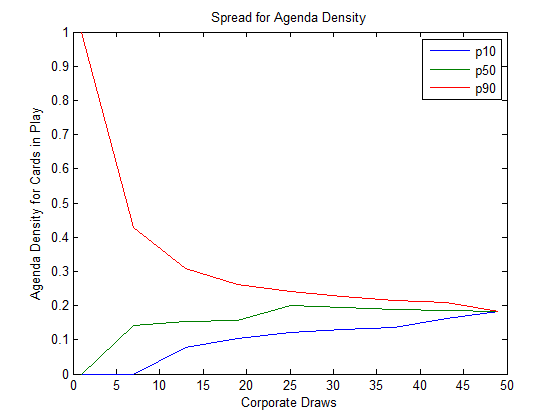
In reality, there will be some variance in how many agenda cards the corp draws. We’ve all drawn a hand where we start with two agenda cards. It’s also common for corps to start with zero. The probability distribution is easily obtained through simulation. The spread is quantified below.
Comments:
Agenda density is the proportion of agenda cards in the game. So if the corporation has drawn 20 cards, there is a 50% chance that he has (0.15)*(20) = 3 agenda cards somewhere in play.
The math is not reliable early game. There is a huge spread across the first 10 cards. On average, he'll have ~2 agendas, but he could have a lot more or a lot less. Do your own risk analysis.
The cases converge as the corporation draws more cards, so this estimation becomes more accurate as the game progresses. After about 25 cards, you can be fairly certain that he has drawn 5 +/- 1 agendas. If only one has been scored, there are probably a bunch in HQ!
Conclusion:
You should now have a fairly reliable way to estimate the number of agendas in the corp’s hand. Divide by the number of cards he’s holding, and get your probability for success. Don’t let the corp sit around with a hand full of agendas.
- Amuk, accountdeleted, operdonos and 2 others like this


20 Comments
So there's only a 10% chance that the corp will be on the p90 or p10 line, meaning that the majority of games will between, close to p50.
Further reading: http://en.wikipedia....wiki/Percentile
Correct. Notice that after 6 cards, the p90 case is that the corp has ~2 agendas. I agree there's a decent chance they'll mulligan this hand, but we can't be sure. The corp might also mulligan a hand with no agendas if he wants to score before icebreakers come out. This is muddy territory, so I didn't touch it.
If the p90 showed 3+ agendas I'd probably go re-simulate it. I still might, but I just woke up
I could rerun it for a standard case with 3/2/1 point agendas, but I'm not sure how much use you'd get out of it. The average agenda is always going to be 2 points, so the median line would stay the same shape.
It's also subjective for the runner if he prefers to run on a hand with 1 3-agenda card or 3 1-agenda cards. Noting of course, that the 1-agenda cards are primarily useful for things other than points!
If anyone else asks, I'll consider running simulations on different agenda point distributions.
This is a very good start, but it could use some more depth!
Good job
On the subject - Does "Corporate Draws" include inital 5 cards drawn? (If I read the graph correctly, it does not, but still want to make sure)
Also, try running the simulation with mulligans.
Assume Corp mulligans all hands with 3+ and 50% hands with 2 Agendas for simplicity.
On the other hand, if he's scored 2 3point agenda, and I've stolen 1 3-pointer, running HQ is less likely to be fruitful. Yes, I could just use your graph, count up the points seen, and multiply by 2 to find an estimate of how many agenda points are likely in hand, but I suspect variance is lower if you model it in agenda points, rather than as cards. Maybe not though.
Like this: http://imgur.com/mJg...ARq80,vd8fGk7#0
Like this: http://imgur.com/mJg...ARq80,vd8fGk7#2
Like this: http://imgur.com/mJg...ARq80,vd8fGk7#1
Thanks!
It does not. And actually, the corp will have 6 cards on his starting turn, but the decision to mulligan is made after seeing only 5, and... it's complicated.
According to your rules: http://i.imgur.com/CdWlK1Q.png
And the original without mulligans: http://i.imgur.com/M3lUgad.png
Basically it puts a discontinuity in the p90 case. As expected, the corp is less likely to have hella agendas in his hand.
There's a point after which you have to use your own judgment
Running a bunch of 3 and 1 point agendas will introduce more variance than running flat 2 point agendas, because it will be possible for the first few agendas that come out to be worth a total of 9 points or 3 points.
10/45 agendas: http://imgur.com/6mlzszL,KRbKTFi#1
11/54 agendas: http://imgur.com/6mlzszL,KRbKTFi#0
All 2 pointers.
Looking forward to it =P
Data Please! Feed me!
All 2 pointers: http://i.imgur.com/UW5Iqx6.png
Standard mix of 2 and 3 pointers: http://i.imgur.com/ygBgvbK.png
Many 1 pointers - typical weyland setup: http://i.imgur.com/nytXAyn.png
Let me know what you get out of this. I see the utility in knowing the theory behind card density, spread, etc, but at this point the actual numbers are lost on me.
Nice article, keep em coming. That goes for TechTalk and Datapack Card Reviews too. Some of the last couple comment threads may have had some negative comments, but I've always appreciated the work people put into these articles.
Thinking about points instead of cards actually makes it simpler to understand, and easier to adapt to someone's actual play. I haven't completely checked my reasoning here, so if you spot something you disagree with, please say so.
When you approach the problem from a points standpoint, you know the expected agenda value of every card: it's agenda points/deck size, usually something like 20/49, so let's say 0.4 agenda points per card. So if your opponent has drawn 10 cards, you can expect those cards to hold 4 agenda points (on average). If you wanted to be completely accurate, you could recalculate whenever you see a new card, to unseen agenda points/amount of unseen cards.
This is actually a more useful way to think about it than amount of agendas, because you can try to judge how those expected agenda points are divided over agendas on a per deck, per opponent basis, and adjust to the agendas you've already seen. If most 3-pointers are already gone or do not fit the deck, 4 expected agenda points probably means that the corp is holding at least two agendas. In the end it's all statistics, so in one game this won't guarantee anything, but in the long run I think this is the most informed way to think about it.
But, at that level of detail, you're probably way beyond the point where additional accuracy will improve your gameplay
Yes. I forgot to remind people that they don't have to actually keep count of cards. It says in the netrunner rules that you can always count the number of cards in a deck, discard pile, and hand.
I use http://www.amazon.co...onic counter e2 When I'm feeling OC
I do use dice, but I pack 4. I set one down every time my opponent takes an action. When I need to access a random card, I roll the appropriate dice. Again, OC.
the predictions for the average case are the same from both perspectives, though indeed I have not calculated how the actual variance relies on over how many cards those points are really distributed, partly because I'm lazy, partly because there's just not much to be gained by such precision. Personally I find counting 0.4 agenda points per card, and keeping in mind that this estimate is less reliable when my opponent runs many high-pointers, and more reliable when they run many low-pointers enough to help making informed decisions, without being too much effort. In the end the expected agenda points/cards are only part of the information you use to make final decisions. The behavior of the Corp plays a major role as well. Counting cards is just a way to better be able to interpret that behavior.
Yes, this is specific for netrunner. I simulated it using a typical distribution of 1/2/3 copies of each card.