
 Card Game DB

 Sign In
 Create Account
Welcome to Card Game DB
Register now to gain access to all of our features. Once registered and logged in, you will be able to create topics, post replies to existing threads, give reputation to your fellow members, get your own private messenger, post status updates, manage your profile and so much more. If you already have an account, login here - otherwise create an account for free today!
Register now to gain access to all of our features. Once registered and logged in, you will be able to create topics, post replies to existing threads, give reputation to your fellow members, get your own private messenger, post status updates, manage your profile and so much more. If you already have an account, login here - otherwise create an account for free today!
 0
0

Fire and Blood - Into the Fighting Pit
Jul 17 2013 05:05 AM |
OKTarg
in Game of Thrones
Small Council Fire and Blood OKTarg Targaryen It's time! Another installment of Fire and Blood! Having not played anything truly competitive since regional season died down, i thought that I might take a step back from championship level builds and efficiency and talk about one of my favorite aspects of the Thrones metagame and the type of gameplay that truly hooked me as a fan upon my entrance into the game. I am, of course, talking about MELEE!
While you can refer to some of our melee-centric articles on this site for a look at the mental and psychological side of the game, I thought that I'd take a look at the Targaryen cardpool and highlight some cards that most sharply vary in power level between the Joust and Melee formats. As most know, melee is a more rush-oriented game while joust sees more control attempts made. That's because in joust you're only trying to control one opponent, while in melee you have to try to control the whole board--a much more demanding task. Alongside this, traditional joust measures of card and board advantage are skewed somewhat. There's less focus on hand control via the intrigue challenge and much more on power manipulation via the power challenge. With those very few basics in mind, let's take a look at some of these cards and talk about how they vary from format to format.
Heir to the Iron Throne (QoD)
The Targaryen in-house agenda is basically the supreme example of these types of cards. While giving up an intrigue or military challenge for a power challenge in joust is usually a foolhardy idea, in melee it is amazing. You have more targets for your power challenges because you have more opponents, ensuring that your claim can count more often. Further, losing the card and board advantages of the military and intrigue challenge hurt less since the total style of gameplay is different.
Heir also gives you THREE challenges that your dragons can participate in rather than the usual two. This makes dragon builds devastating in melee and is often reason enough to run this agenda. Though Dragons have seen some recent joust success, in melee they are almost unstoppable.
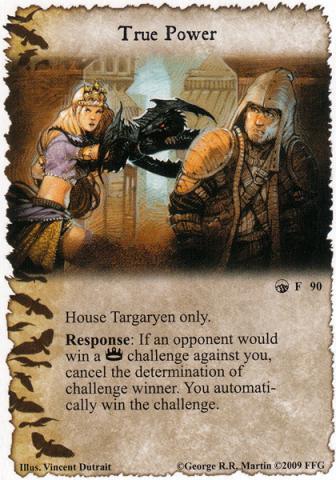
This card is another beneficiary of the Power challenge moving from the least important in joust to the most important in melee. Ensuring your renown or your power claim or being able to trigger your Make an Example are all easy situations where True Power works a treat.
I actually like to use this card on defense, ensuring that my characters can remain standing for the counterattack on my knelt-out opponents. If they're bringing Vigilant attackers, so much the better, since they won't get the standing effects they were counting on! This card is close to an auto-include for me in melee while I don't think any championship level builds use it in joust at this time.
Khal Drogo (WotN)
While you have probably never used this Khal in your joust decks, he's a pretty solid card in both formats. However, in joust, he is edged out by the Core set Khal for versatility or by the Dothraki search Khal out of the Queen of Dragons box in Dothraki builds. But in melee, he is often my choice due to three very important factors:
1. Renown. Renown is often how you close out a game in melee, and Targaryen doesn't have a lot of in-house choices for this keyword. This Khal has it.
2. Noble crest. While you may want to use Power of Blood for your own protection, very often your opponents will be using it for theirs. Sliding Khal or Daenerys Targaryen into the safety provided by their plot can be a great thing, especially on a Valar turn.
3. Targeted kill with no card loss. While control in melee can't usually control all of your opponents, nobody wants to be that one that you choose to target. This Khal gives you a great option of a targeted kill to threaten/negotiate with on top of his Renown and overall utility. You're making threats and promises while keeping all of your cards in hand.
Flame-Kissed (Core)
Flame Kissed might be my single favorite Targaryen card. It's so good--challenge control, spot kill, ambush, recursion with Lady Dany's Chambers--that in joust I never leave home without my trusty 3x. In melee, though, it is a different story many times.
Burn is pretty card intensive if you're really going to make it count, and you just can't put out enough burn cards to eliminate threats from three opponents. That means that Flame Kissed is a card that I almost never use in melee. Burn in general is the type of thing that you might want a few devastating effects for character control, but you can't build around it. That means cards like Incinerate or Sun Stroke are generally better options for your burn slots than this old stand by.
Daario Naharis (WLL)
Daario, along with his counterpart Jorah Mormont, are great characters that also remove someone from your opponent's board. In Joust, Jorah is the choice, since Allies see more play. But I think Daario is often overlooked in melee. Knight builds are pretty prevalent, and the melee keyword helps you get maximum strength from the fewest possible characters commited. Using melee Daario via the Kingsguard redirect mechanic is simply fantastic.
While in joust, you often can have a Daario in your hand that you can't marshal, in melee that's almost never the case. Don't leave home for a melee tournament without this guy.
Meraxes (TBC)
Meraxes is GREAT in both formats, don't get me wrong, but the often-overlooked fact about this card is that it lets all opponents who didn't attack you also draw a card. That's a pretty good carrot in the "don't attack me; attack him!" negotiations that often go on during a typical match. Also, since every last power token counts, the Dominance boost can really come in handy.
I hope you've enjoyed this all-too-brief look at some underused cards and techniques that shine in melee play. I'd love to hear what you Targs are playing in melee at the moment as we bide our time between regionals and the new FAQ! Comment below!
Also, if you're interested in doing a guest spot here in this space, I'd love to hear from you! My life outside of Thrones is getting ever more busy, so an installment off here and there is not only good for our readers but also really good for me. PM me here on this site (OKTarg) and let me know what you're eager to share! Thanks again for reading, and keep on burning those opponents down to the ground!
- bigfomlof, emptyrepublic, mishuoprescu and 4 others like this


5 Comments
Can't agree more on True Power (AKitN): it can make your day or ruin someone else's.
While a BURN focused deck is usually weak in Melee, long term strength reduction can still be good.
Some burn cards I love out of Targ in melee are Meereen Tourney Grounds (ODG) and Poisoned Wine (Core). Even if you don't have the most uniques for the -3, often the -1 is enough to stop a key challenge. The wine can move around easily in any player action window for a -2.
Most importantly, these cards can affect challenges that aren't even made against you!
Controlling the Tourney Ground and/or a Wine can give you a lot of bargaining chips as you form those "don't attack me! attack him!" alliances.
I would add Horseback Archers (QoD) because you can jump into any challenge and Sun Stroke (QoD) because you can loose a challenge against another player than the owner of the character it is attached to.