
 Card Game DB

 Sign In
 Create Account
Welcome to Card Game DB
Register now to gain access to all of our features. Once registered and logged in, you will be able to create topics, post replies to existing threads, give reputation to your fellow members, get your own private messenger, post status updates, manage your profile and so much more. If you already have an account, login here - otherwise create an account for free today!
Register now to gain access to all of our features. Once registered and logged in, you will be able to create topics, post replies to existing threads, give reputation to your fellow members, get your own private messenger, post status updates, manage your profile and so much more. If you already have an account, login here - otherwise create an account for free today!
 1
1

Forging the Chain - Jaime Style Pt. 1 - Efficiency
May 06 2013 06:20 AM |
TinyGrimes
in Game of Thrones
Small Council Forging the Chain TinyGrimes It has been noted lately that there is a dearth of Jaime related AGOT articles. Since I'm about as Jaime as they come I thought I would write a short series of articles from the perspective of the Jaime player. This week the focus is on efficiency. While in my own head this term and its application to AGOT is quite clear, I have recently realized this is simply not the case for many, especially newer players. My moment of realization occurred most emphatically when an up and coming player asked how to build a good Greyjoy deck. I said well that's pretty simple, throw in a pile of saves, cancels, and efficient characters. She followed up with "what makes an efficient character" and that question is the impetus for this article.
So let's start with a basic definition. An efficient character is one who has either an effect which alters the board state or provides card advantage, has a really good cost to str ratio, has a repeatable effect, or does something remarkable. What makes efficiency a bit more difficult is that what makes a character efficient varies from house to house. For instance, Greyjoy has a multitude of 3 cost efficient characters. So many that I almost never put a 4 cost character in my decks. Why would I with so many effective 3 cost characters? However, in Baratheon many of their best characters are 4 cost. If there is interest in this specific topic I would be happy to write another article focusing on the different ways to measure efficiency for each house.
Cost Ratio: This is the most basic category for measuring the efficiency of a card. Essentially, a card should have a cost that is justified by their strength and icons. Usually a 1 cost character will be a mono-con with 1 or 2 strength. A 2 cost character will be a bi-con with 2 strength and 2 icons. A 3 cost character should have 3 strength and 2 icons. While a 4 cost characters should have 3 strength and 3 icons or 4-5 strength and 2 icons. Now all of these numbers can be modified by the strength of the text on the card. For example, Robert Baratheon (Core) costs 4 and only has 3 strength and 2 icons, so at first glance he is not efficient. However, his keyword is renown which bumps him up significantly and when he claims for renown he claims and additional power. This bumps him into the ultra efficient category. The same hold true for Melisandre and her text. While she looks somewhat pedestrian from her basic stats, her keyword and text are phenomenal.
There are many characters which greatly exceed the basic numbers I outlined above and these are also examples of ultra-efficient characters. The Distinguished Boatswain (TftRK) is probably the greatest example at 1 cost for 4 strength. The refugees were restricted because for the low low cost of nothing you got a bi-con with 2 strength. The Hungry Mob (CoS) at 0 for 3 are also a primary example along with scores of others such as Lost Spearman (MotM). Another reason why these lowcost, high strength characters are so strong is the setup support they provide. So in addition to getting under costed characters you are able to quickly setup your board and see more of your deck quickly. Thus, by putting pressure on your opponents and seeing more cards you have upped the efficiency of your entire deck.There are also well costed characters that are more expensive. For example, in a wildling deck the The Wildling Horde (TWH) costs 4 for an 8 strength bi-con with deadly and a warcrest.
This category gets more complex when you look at characters with favorable cost to strength ratios that are actually inefficient. The War Host of the North (Core) costs 7 and has an impressive 11 strength. I have seen many new players drool over this card. However, it is wildly inefficient. Paying 7, especially in Stark, is difficult and is probably your entire turn. Moreover, all you get in a military icon which Stark has oodles of good ones for much cheaper.
Repeatable Effects: Let's look at some examples of efficient characters starting with those containing repeatable effects. Put simply repeatable = efficient. Alannys Greyjoy (ODG) costs 3 and has repeatable cancel. Maester Wendamyr (KotS) costs 2 and has repeatable saves. Those 2 cards are phenomenal. You might be saying ok I got it. So Salladhor Saan (KotStorm) is efficient. Here is where it gets tricky because the answer is no, at least he wasn't before. The reason he is not efficient is his 4 cost, ally trait, and only 2 strength. This means the second he hits the board he is vulnerable to multiple threats before he can perform his repeatable action even once. Both Flame Kissed and Dissension will find him a tasty target. Core Ser Ilyn Payne suffers from the exact same condition. I have seen many a new player break him out with a smile only to see their 4 gold disappear to an immediate dissension.
Robb Stark (Core) is a card with a repeatable effect that new players often salivate over. Free kill, huzzah! However, at 4 cost and 2 strength he just is not effecient. First, Stark has many ways to kill characters, this really isn't an issue. Second, at 2 strength Robb is highly vulnerable to Targ burn and Venemous Blade. So essentially his kill effect doesn't add that much to a house swimming in kill and he is overcosted for his strength.
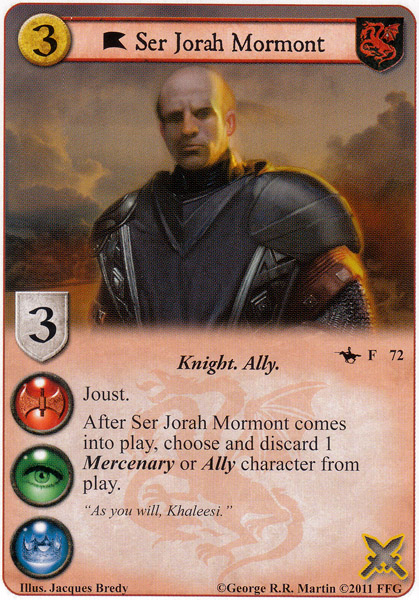
Card Advantage: Another tell tale sign of an efficient character is one who provides card advantage. There is a reason The Viper's Bannermen (PotS) are on the restricted list. When a card provides 4 other cards just for coming into play and then dying you are looking at an ultra efficient card. Other examples of this are the House Messenger (PotS) and the Flea Bottom Scavenger (AToT). The efficiency of these cards is magnified even more when you bring them into play with Flea Bottom because you are essentially paying 0 gold for claim soak and more cards. Also, when you can bounce them back to hand with your own First Snow you can exploit them again for even greater card advantage. Other cards like Luwin, Jhogo, Reader, and Gilly provide cards just for winning challenges. In fact at 0 cost I dare say Gilly is the most efficient card in the game if you are running summer.
Non-Kneeling: Cards that do not kneel to attack are normally efficient as well since they essentially act as 2 or more characters. There is a reason every PbTT deck plays 3 copies of Cersei Lannister (LotR). She gets to participate in 3 challenges every turn and has amazing text. Now that is an efficient character. The Northern Cavalry Flank (SA) is another primary example. While I loathe including 4 cost characters in my Stark decks the Flank always makes the cut. Asha Greyjoy (WLL) at 3 cost with renown may be the best of this bunch.
Not all characters who don't kneel to attack are effiecient. The trickiest character for this categories is King's Landing Littlefinger. In a deck with tons of shadows cards, running PbTT, he is an ultra-effiecient character. Putting out a character for 2 cost with 3 str, stealth and doesn't kneel to attack on three challenges is great. However, paying 5 cost for him only to see him discarded immediately will set you back an entire turn and may cost you the game.
Synergy: Sometimes a card's efficiency can be improved through synergy with other cards in a deck. For instance, noble crested cards in a Baratheon deck with loyal guards, Royal Entourage, and power of blood become more efficient because they are more resilient than other cards. Thus their sheer staying power makes them more efficient. The best example of this synergy is the Martell Maester from last year. The maesters on their own are lackluster. However, when put together they shine. Each of them reduces the cost of playing the Conclave and the Maester of War provides them each with a military icon.
Static Effects: There are a number of cards which affect the entire board and this increases their efficiency dramatically. My favorite example of this is Baelor Blacktyde (TIoR). His affect is amazing against many decks such as Martell especially in combination with the many cancels which Greyjoy has access to. For example, your opponent plays a Westeros Bleeds and you cancel it. Next turn you play Baelor Blacktyde and now until he leaves the table your opponent cannot play another Westeros Bleeds. With one card you just shut down the whole point of their deck. Now that is efficient! The Laughing Storm (GotC)is another excellent example a powerful static effect. Often Baratheon is lacking in intrigue icons and a quick Lannister deck can decimate a Baratheon player's entire hand quickly. However, if the Laughing Storm is standing no cards are lost to intrigue challenges.
Card Text: Finally, a card's efficiency can be augmented by its game text. For instance, even though The Red Viper (PotS) costs 5 he is an efficient 5. He has renown, is resilient through his immunities, and often does not kneel to attack. Other cards have less powerful text but are cheaper such as the Painted Dogs (IG) who at 2 cost can help win challenges. Or Willas Tyrell (VM) and his amazing anti Lannister/Martell text.
Examples
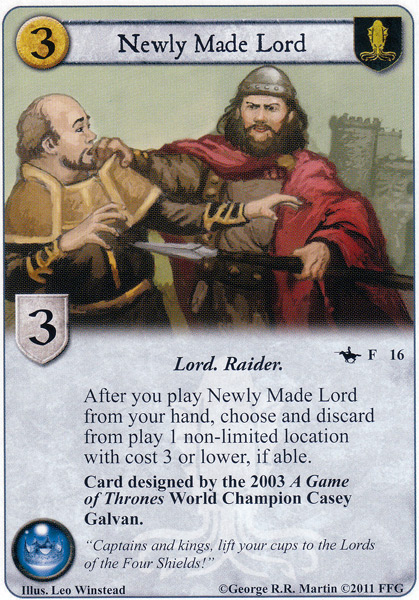
Let's contrast him with KoTS Salaador Saan. First Saan costs 4 which puts him in the same bracket as Melisandre, Stannis, and Robert Baratheon. These are some of the best characters in the game. Ok you've decided to play Saan. You drop him on the board. Before you can take your next action your opponent can play a Dissension or a Flame Kissed to instantly remove him. They could instantly play a Distraction or a You've Killed the Wrong Dwarf to kneel him. They could play a Nightmares and blank him. Now let's assume none of these happened. When you try to trigger his response your opponent could have a myriad of means for cancelling his response such as He Calls it Thinking, Alanys Greyjoy, or Seasick. Now he is knelt and you have paid 4 for nothing. But that's ok next turn you will surely use his ability, right? Maybe. So the challenge phase starts and your opponents brings out of shadows a Varys or a Venemous Blade and takes him out. Perhpas your opponent wins a challenge and kills him with Die by the Sword, No Quarter, or Incinerate. Hopefully, by now you've seen a pattern. Your 4 cost repeatable character is exceedingly vulnerable. You may very well pay 4 gold for a character you never get to use. This is not an efficient use of your gold.
Well hopefully this brief excursus on efficient characters has shed some light on how Jaime players select their character base. In my estimation, the secret to ultra competitive deck building is to include as many efficient cards as possible. It's often the inclusion of these cards which separates the good decks from the great ones.
CardGameDB is looking for more articles written from a Jaime perspective, send Darksbane a message if you'd be interested in contributing.
Tiny Grimes recently migrated over to AGOT, in January 2012. Tiny spends most of his time not winning SoCal regionals. He has played in four regionals, placing 2nd, 3rd, 3rd, and 8th.
- badash56, bigfomlof, Kennit and 5 others like this


15 Comments
Shagga - playing to combo
Ned - playing thematically
Jaime plays whatever wins. Although "Control = Win" has been true for AGoT for quite a long period, so your confusion is understandable...