
 Card Game DB

 Sign In
 Create Account
Welcome to Card Game DB
Register now to gain access to all of our features. Once registered and logged in, you will be able to create topics, post replies to existing threads, give reputation to your fellow members, get your own private messenger, post status updates, manage your profile and so much more. If you already have an account, login here - otherwise create an account for free today!
Register now to gain access to all of our features. Once registered and logged in, you will be able to create topics, post replies to existing threads, give reputation to your fellow members, get your own private messenger, post status updates, manage your profile and so much more. If you already have an account, login here - otherwise create an account for free today!
 0
0

Forging the Chain - Shortcuts
Dec 13 2012 09:10 PM |
TinyGrimes
in Game of Thrones
Small Council Forging the Chain TinyGrimes
Forging the Chain: Shortcuts
Welcome back to another edition of Forging the Chain. This week I'm going to revisit a recent podcast by 2 Champs and a Chump in which they discussed an article by Chingsung Chang. I will only examine the issue of shortcuts and how they relate to your play testing. I have already written articles on play testing so this may simply be redundant. However, I think it will provide more detailed examples of why play testing is useful.
A shortcut is essentially information you have already required regarding a game situation. Play testing is what allows you to acquire these shortcuts for each deck. In this article I will use my Martell Maester deck as the reference point since most people have either seen the deck or heard plenty about it. Let's look at some examples of creating shortcuts.
Opening Hands: Do you mulligan or not? There are many levels to this question. The most basic is can you do better? In your play testing you should have acquired information regarding the average flop you can put out. This number is not simply quantity but quality as well. However, there is perhaps a more important level to this shortcut based on matchups. Is there a particular card you really need for a matchup. For instance, against another maester deck Game of Cyvasse is critical. If the deck runs powerful events you may want to keep a lesser hand with a cancel in it. In certain matchups Leyton Hightower is critical.
Plots: In this matchup do I want to go first? Is it critical I don't go first? Does my deck have a plot cycle that I prefer to use? Do I need to break this cycle in this particular game? Your playtesting should provide you shortcuts to help you answer all of these questions.
Ser Arys Oakheart (PotS): When do I use him. He is a renown character so I would like to play him for my To the Spears turn. Do I need to save him for a particular ally or can I just plunk him down and crush any ally?
Chains: Who do I put my chains on and in what order? Can I put my chains on the Maester of the Sun? Putting chains on a character with Vengeful is ideal. However, is my opponent running First Snow or Venemous Blade? Should I put the Apprentice Collar on first or can I get away with a different order based on my needs in a particular situation. Against Stark this choice is obvious, Apprentice Collar first nearly every time.
A Game of Cyvasse (ACoS): This is the control element of the deck. What do I use it on? Should I hit Cersei with it early before she gets duped up or should I try to wait until she grabs a bunch of power? There is a good chance this will be the only control card you see all game so use it wisely.
He Calls It Thinking (PotS): There are so many great responses which one do I cancel? In our testing against Stark decks we decided that it was not worth cancelling Samwell Tarly's draw due to the massive amount of devastating events Stark Murder would play. In Bruno's top 8 loss to Dan he used his HCIT on Sam and promptly lost a valuable character to a kill event which essentially lost him the game. After the game we talked about this and Bruno felt that in that particular instance breaking the shortcut was the right move. The point is not that Bruno broke the shortcut and lost because of it, but rather that by knowing the shortcut existed Bruno was able to make a more informed decision.
Dissension (QoD): Along with Copper Link this card was devastating. What is the one character in a matchup you have to remove? If there is not one then you are free to use the combination more liberally. If not it might be better to save it for that one character. For instance, against Greyjoy, Farwynd is the deck's Achilles heel. Dissension or Oakheart should be saved for him.
The Hand's Judgement (TTotH): This cancel is interesting because it requires a gold. So if you are worried about a marshalling event such as Copper Link and Dissension it is critical that you go first. This makes playing against Lannister Maester especially tricky since it violates the other shortcut of going 2nd against Lannister.
We do all this play testing to create shortcuts so the game is more manageable and we have critical information at our fingertips. However, it is key that during games we do not blindly follow these shortcuts. This is information or a roadmap, but roads often require construction or have heavy traffic and an alternate route is required. This can be most easily illustrated with the plot deck.
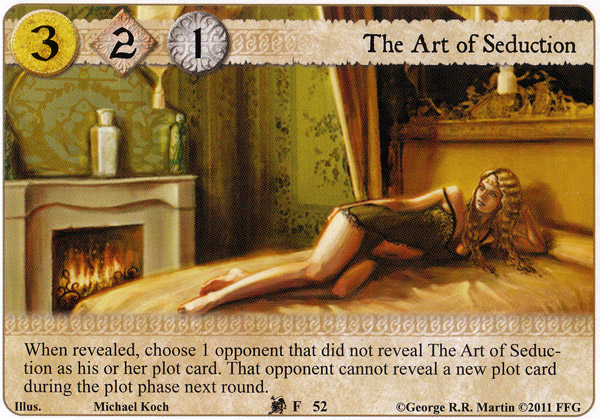
Yet another wrinkle in this plot deck shortcut is Forgotten Plans (KotStorm). We realized that the worst case scenario was The First Snow of Winter (ODG). Since the deck spits out so many small maesters, a first turn First Snow followed by Rule by Decree could be very bad for the deck. So a new shortcut was put into play. Some games Gates would be replaced by Forgotten Plans. The funny thing is this new shortcut cost me a regional. After sweeping through undefeated I met up with Bruno in the finals. After flopping one maester and Arianne I had a critical decision, which shortcut would I use. My thought was Bruno would assume I would play Gates and at least one other maester and then follow with a Conclave or 2. Therefore, Bruno would play First Snow. So I plopped down my Forgotten Plans. Instead he played Search and Detain and bounced Arianne back to my hand. I drew no maesters and therefore was left with a board of something like one maester and a house messenger. He threw down Aegon's Hill and proceeded to kill my Conclave and everything else for an easy victory. Had I chosen to play Gates that first turn I would have had 2 maesters and enough gold to put down a Conclave. That is a massive difference in board presence.
So to conclude this laborious entry, shortcuts are essential but must always be questioned. They are there so you can just play the game. That is, they provide the background information that allows you to make innovative decisions at the table. You don't have to think through all the basic or even intermediate decisions, these are second nature. Your mind is free to make the Bruno level decisions, if you can find them. In short, come prepared but question everything. Until next time, keep improving.
Tiny Grimes recently migrated over to AGOT, in January 2012. Although he has not played the game long, Tiny spends far too much of his time playing and thinking about the game. He has played in four tournaments, placing first in a 15 person local event, 2nd in the 2012 Pasadena Regional (32 players), and 3rd in the first regional of the 2012 season (32 person event - Kingdom Con), and 10th at Gencon 2012.


0 Comments