
 Card Game DB

 Sign In
 Create Account
Welcome to Card Game DB
Register now to gain access to all of our features. Once registered and logged in, you will be able to create topics, post replies to existing threads, give reputation to your fellow members, get your own private messenger, post status updates, manage your profile and so much more. If you already have an account, login here - otherwise create an account for free today!
Register now to gain access to all of our features. Once registered and logged in, you will be able to create topics, post replies to existing threads, give reputation to your fellow members, get your own private messenger, post status updates, manage your profile and so much more. If you already have an account, login here - otherwise create an account for free today!
 2
2

Rise of the Kraken - Deck Building
May 10 2013 05:10 PM |
JCWamma
in Game of Thrones
Small Council Rise of the Kraken JCWamma This week on Rise of the Kraken we're going to be looking at a more general subject of deck-building and card ratios, a subject that is important to learn and difficult to master. This is a weighty subject for any deck from any house, but a particularly difficult one for a Greyjoy player to tackle. Read on to learn more.
This article was sparked by a post on the forums by fellow Small Council member ShadowcatX2000, pondering how many War Crests with Military Icons you should include in a deck to justify running three copies of Die by the Sword (LoW). He was using this as an example for the more general question - when you want to include a card in your deck that relies on other cards in the deck, how many copies of those other cards do you need in order to justify including the first card? Conventional wisdom states that in this instance, for each War Crest event in your deck you should include three cards that it can trigger off (with that number being reduced according to your draw and search effects), and having 'mental shortcuts' such as this is handy when deckbuilding, particularly for new players. However, it got me thinking about the deeper complexities of deck-building, and what other factors you should consider.
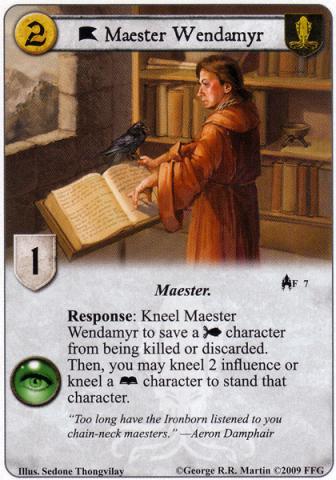
This is a tough question for any deckbuilder, but in Greyjoy it is particularly difficult for one very important reason - saves. To go back to the War Crest question, can you include less of those War Crest characters, then use Maester Wendamyr (KotS) to preserve those that you get into play? Of the 16 War crest characters Greyjoy have, 11 are Ironborn - does adding Maester Kerwin (VM) make them more reliable? What about Salt Wife (AE)? For the latter, how much influence do you need to run to have that Response be reliable? For those hoping I'm now going to say "six" and move onto the next question, bad news - we're looking at what you need to consider when you build your deck. Every card in your deck is dependant on every other card, and there is no one 'answer' to this type of question, only variables to take into account.
For an example of another Salty card, consider Support of Saltcliffe (GotC). Although it's been errata'd to "limit three times per round", a Response that lets you stand a character is a very powerful effect - ask a Maester player who they wouldn't kill for that effect and you might get a disturbing answer back, even for a Greyjoy player. But it is very conditional (and that's not meant as a pun on its trait). There are many layers you have to peel back to get to that result of standing the character. Firstly and most obviously, you need a character to attach it to. A Greyjoy deck typically skews slightly lower on characters because of our plethora of saves. This leaves more spaces for cards like Support of Saltcliffe, but also leaves less valid targets - although then again, those targets are generally more resillient, which in turn makes the card more valuable as its less likely to be killed by an opponent. As well being a character, its target must have the Ironborn trait. Despite Greyjoy's huge surplus of Ironborns, this is still an important limit - for instance, without some Copper Link (GotC) trickery (or other trait manipulation) you won't find a Maester that can take the attachment. Another aspect that, while obvious when you consider it is nonetheless fairly easy to overlook, is whether the character can take attachments. Giving the attachment to your Iron Fleet Raiders (MotA) might seem like a clever combo to stand them when their STR is lowered, until you remember they can't take the attachment in the first place. When counting the Ironborns in your deck, it's very easy to overlook their text. Another example of something to consider when judging how many valid targets you need for the attachment would be resilience - take Island Refugee (RoW), which is a valid target for the attachment but probably not a smart one, because of the fragility of the card involved. Conversely, in the case of Finger Dance (WLL), which also requires an Ironborn, the fragility of the Refugee is not such an issue and is if anything a boon since it means you're not kneeling a more powerful card for your cancel.
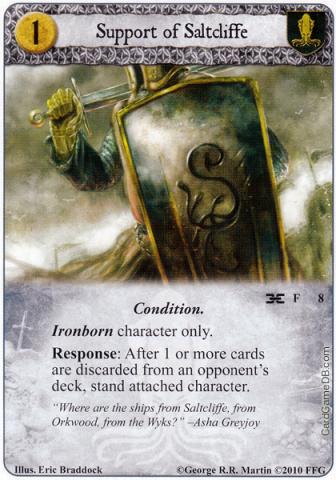
The biggest thing to consider with a card like Support of Saltcliffe, however, is the likelihood of triggering the response once you have been able to attach the card. There are numerous things to take into account here - how many effects do I have that can discard cards from an opponent's deck? How likely is it that I can trigger the effect? How often are they to be occuring when the attached character is knelt? For instance, the aforementioned Finger Dance guarantees a knelt Ironborn, and combined with Saltcliffe can form a delightful combo where the character kneels for Finger Dance and immediately stands, but relies on the opponent playing an event in order to trigger it; conversely, Frostfang Peaks (TWH) is guaranteed to discard a card (subject to you revealing a plot card and not having the Response cancelled, of course!), but what are the odds of your character being knelt at that point? And the intricacy doesn't stop there. You also need to ask yourself, how important is it that you can stand your Ironborn characters in the first place? The answer will depend on the board position, which will in turn depend on the deck you are playing against. And that's the elephant in the room, because what deck you are playing against has a serious effect on the value of cards.
To go out of house and onto the greenlanders for a moment, consider Willas Tyrell (VM). If you were a Baratheon player you might think to yourself "I should protect him in case he gets killed", and consider equipping him with protection such as Lightbringer (Core). But the reason you would want to protect him are for your match-ups against Lannister and Martell, and those aren't the houses likely to be packing kill events - Lannister's only kill event of note that sees common play is Terminal Schemes (LotR), and pleasingly Willas is House Tyrell and unaffected by it. That copy of Lightbringer will only be truly useful against Stark and Greyjoy, at which point Willas's effect is widely useless. This isn't the sort of thing you should immediately know, and generally comes from playing with lots of different types of decks against lots of opponents; that said, taking it into account will help you build better decks.
To bring this back to the boats and Support of Saltcliffe, consider when that effect will be most useful. It will be for one of two reasons - because you want to stand characters you've knelt, or because you want to stand characters your opponent(s) has/have knelt. Your in-house effects should receive more weighty consideration, since those are the ones you can guarantee being a factor in a game, but you also must consider what you are facing. This isn't as simple as knowing your meta, although that's certainly an aspect. You also need to take into account what type of decks will run kneel effects, and what effects you can trigger to stand characters. In this case, the most common opponents to run kneel will be those from House Lannister. If your chosen method of discarding cards to trigger Support of Saltcliffe is to get unopposed challenges and then trigger The Reader (TGF) or Raiding the Reach (TGM), your effects are less likely to work, because they have Enslaved (THoBaW) to take your Wex Pyke (KotS), and one of their most popular restricted cards is Pentoshi Manor (AHM) which can remove the Stealth and Intimidate keywords. Do all these factors make Support of Saltcliffe a bad card? Well, no, but they do make it a card you can't just throw in every deck, and with good reason. Analyse your deck carefully before including it, and weigh up the risk of it being destroyed, becoming a dead card or not being able to trigger against the reward of it being able to stand a character - how relevant is the stand for you? If it's letting your
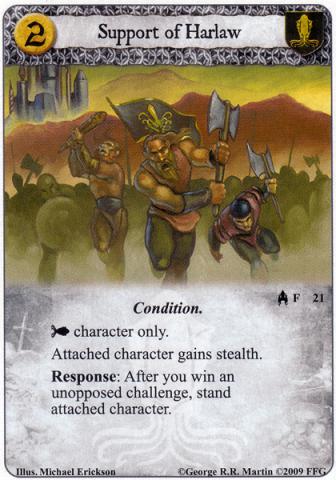
Ok, you might be thinking - what about using Support of Harlaw (KotS) instead? That gives the character Stealth, isn't limited to going on an Ironborn character, and has a condition a typical Greyjoy deck is more likely to want to trigger, that of winning an unopposed challenge. This card, however, brings with it its own problems. Firstly, by being limited to "when you win an unopposed challenge", that dictates when you can stand your character a lot stronger as, short of epic battles or cards like the out-of-house Lucas Blackwood (GotC), you're only going to be triggering that effect in the Challenge phase - and while that is the phase you're most likely to want to stand your character, it's still something that needs considering. Secondly, and perhaps more importantly, the attachment costs more. You'll often find that the less conditionally good a card is, the more it costs - for instance, Distinguished Boatswain (TftRK) and Euron Crow's Eye (ASoSilence) are both STR 4 Ironborns with a military and power icon. Euron also has an intrigue icon, the sought after Lord and Raider traits, a War Crest, Renown and an amazing piece of passive text that makes Martell players weep, sometimes for days on end - and on top of that, he's good even when there are cards in Shadows, whereas Boatswain turns useless in those conditions. However, Euron costs five times as much as our Boatswain, which makes the latter see a lot more play. You might also decide you need that STR unconditionally and go an extra step, adding The King's Law (KotStorm) to the plot deck - and how your deck interacts with your plot deck is another vital thing to consider, perhaps THE most vital, but I won't go into that now for lack of space.
The point here might seem somewhat trite - "hot scoop, more expensive cards are better than cheap ones" - but it's important to think about what justifies the extra cost if you're including the card in your deck. Do you need reliability in your cards at the expense of...well, expense, or will you take the highs and lows of a conditionally incredible cheaper option? The correct answer should depend on the choices elsewhere in your deck.
Most of the article has been spent discussing conditionality, but it's also important to take into account how important an effect is to your deck, and how much it would cost to trigger it. For instance, the initial question concerned War Crest events - but in Greyjoy, we're not that bothered about running The Price of War (KotS), because we have Newly Made Lord (TftH) to discard locations. We'd rather run Die by the Sword (LoW) since otherwise a Greyjoy deck tends to lack direct kill. Alternately, you might decide that you really don't like locations and what matters most to you is the redundancy of the effect - that is, having lots of ways of removing them. Doing so then allows you to run cards that benefit from your opponent having a locational disadvantage, such as Seasick (KotS). Meanwhile a Targaryen wouldn't have this luxury and would be happy to run The Price of War if they included enough War Crests, because otherwise they seriously lack any efficient location removal to the extent that they often dare to run OUR Lord out of house!
The other aspect of this matter of efficiency is considering the cost of your effect. For example, you're a lot more likely to want to trigger Confession (KotS) using your Follower of Two Gods (CD) than you are using your Victarion Greyjoy (VD). So is it worth running the Confession at all if your Holy crest characters all cost three or more? This is a matter of efficiency of effects, and is too broad a subject to talk about in this one article - although hopefully it will be addressed somewhere on this site before too long!
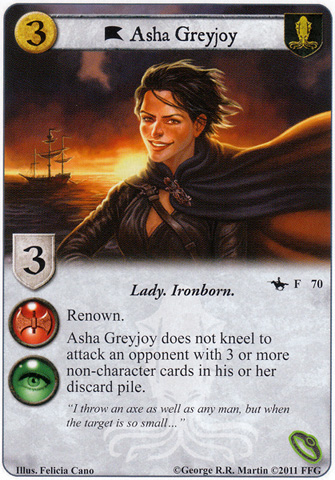
It's also worth noting that some cards are just simply undercosted. If you made a graph of cost on the x-axis and brilliance on the y-axis, these lie high above the curve. We're talking here about the likes of Maester Wendamyr (KotS), Asha Greyjoy (WLL), the aforementioned Newly Made Lord (TftH) and Distinguished Boatswain (TftRK), and their ilk. If a card's text and/or STR is so good for their cost, you will have to have to work hard for a reason not to include them. For a player newer to the intricacies of deckbuilding, I'd recommend starting off with these cards, then letting the deck grow around them according to what theme you want the deck to have - for instance, taking these cards, then deciding you want it to be a Raider deck, adding the Euron mentioned above as the deck's 'marquee' card so to speak and then looking at the cards that efficiently synergise with them. Or perhaps deciding you want to take the deck in a more frosty direction and adding Wintertime Marauders (ACoS) and other efficient Winter-based cards. The only limit is your imagination! And the cards, always the cards.
That's it for this article. Next time we'll be back in the reliable hands of tibs3688, who is taking a look at HoD longship grief raiders. Until then, good-deckbuilding!
- mischraum, bigfomlof and celric like this


9 Comments
I go a little higher than JCWamma's 25% on this one.
For a normal setup deck, my cost reduction math is based on will this street/effect reduce the cost of 1/3 of my deck.
Without twenty uniques no Street of Silk (LotR); Without twenty nobles and/or warriors no Ocean Road (WLL); Without 20 Int Icons no Shadowblack Lane (Core); etc
For House of Dreams (ARotD) (where 0 cost locations have more value) I drop down to 15.
I also make adjustments depending on what in-house options are available. For example, if you were to build a Targ deck (*purely to playtest against your Greyjoy deck of course*), you'd probably drop your least likely to be used street for
Great Pyramid of Meereen (AHM). But even a card as awesome as that could get pushed out. Hypothetically, if you were playing an expensive-location/attachment heavy variation that doesn't rely on influence and ran Summer (*bleh*) Myrish Villa (QoD) is a more efficient include.
Yet what has worked for me is based on the cost curve of my decks (and on the relativity of a reducer location's value based on the cost curve, I agree with JCWamma 100%)