
 Card Game DB

 Sign In
 Create Account
Welcome to Card Game DB
Register now to gain access to all of our features. Once registered and logged in, you will be able to create topics, post replies to existing threads, give reputation to your fellow members, get your own private messenger, post status updates, manage your profile and so much more. If you already have an account, login here - otherwise create an account for free today!
Register now to gain access to all of our features. Once registered and logged in, you will be able to create topics, post replies to existing threads, give reputation to your fellow members, get your own private messenger, post status updates, manage your profile and so much more. If you already have an account, login here - otherwise create an account for free today!
 0
0

The Grand Melee - Balance Theory and Negotiations in Oldtown
Sep 09 2013 06:00 AM |
celric
in Game of Thrones
Game of Thrones celric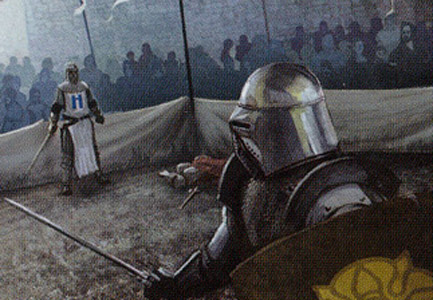 Looking At AGoT's Balance through the lens of the Small Council Titles and Effects
If you only play joust, it can be easy to miss the some of the balance inherent in the mechanics of 'A Game of Thrones.' Let's take a look at how the Melee titles display the equivalency of effects within AGoT's design.
- King Regent (Power +3)
- Captain of the Kingsguard (Military +3)
- Master of Whispers (Intrigue +3)
- Master of Coin (+2 Gold)
- Master of Laws (+1 Card)
- Hand of the King (+2 Influence)
3 Power = 3 Military = 3 Intrigue = 2 Gold = 1 Card = 2 Influence
We're starting to see the designers play with this concept in The Banner's Gather by using "discard 1 card" as part of the cost to play effects. Here are some examples:
- Alester Florent lets you pay 1 card to give a character +3 STR during Power challenges like the King Regent.
- Damon Marbrand lets you pay 1 card to give a character +3 STR during Intrigue challenges like the Master of Whispers.
- After you've knelt Southron Stronghold for 1 influence, you can pay 1 card stand it and get a 2nd influence from it this turn similar to the Hand of of the King.
General Theory of Relativity of Card Effects
While many articles and commenters have talked about efficiency of cards, I wanted to get down to the measurable math of AGoT card effects. If you'd like to contribute to that discussion, please join the research reply on the related thread Theory of Relativity of Card Effects.
This topic is potentially huge, but today I'd like to focus on the simplest and truest exchange on the effect market...
1c=2g
That's right, one card equals two gold is as reliable a theory as (!possible spoilers!) R+L=J. So while it's not 100% its as close as we'll probably get.
Look through the AGoT card base and you'll find repeatably adding cards to your hand tends to cost two gold to marshall (examples: Golden Tooth Mines (Core), Shade of the Evening (QoD), Valyrian Steel Link (HtS)). Effects that offer a better return (like Pyromancer's Cache (TWot5K)) are often restricted.
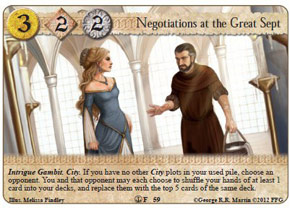

Has anybody besides me wondered if the Dos Equis guy is pictured in this card?
Stay Thirsty My FriendsSince 1 card equals to 2 gold, it's hard to explain why Negotiations at the Great Sept (TPoL) shouldn't be restricted. If you have 1 card in hand when you reveal it, you get 4 cards. Everyone knows that getting 4 cards is awesome, but this is essentially the same as getting 8 gold.
Imagine a Plot that gave 7 gold, 2 Initiative, and 2 Claim with no other text - that thing would be restricted immediately. Yet somehow FFG let a 11-2-2 plot ride through unrestricted until people were preparing for GenCon. For Jousters it was fun while it lasted, but for Melee that party is still going strong!
Negotiations in Oldtown
Preparing for the Vancouver regional I deeply believed that NatGS was the most powerful unrestricted card in AGoT. Naturally, I built my deck around it. Unfortunately, my meta mate and I were unable to make the trip to Vancouver so this thing never saw action under the big lights. However, the deck has retired gracefully to the Melee pasture.
House
House Martell (Core)
Agenda
House of Dreams (ARotD)
Plots
A Time for Ravens (ACoS)
Called to Court (ODG)
Negotiations at the Great Sept (TPoL)
Outwit (TIoR)
Rule by Decree (Core)
Schemes of the Scholar (HtS)
Valar Morghulis (Core)
Characters (32)
Archmaester Marwyn (MotA)x2
Arianne Martell (PotS)
Darkstar (PotS)
Ellaria Sand (PotS)
Grand Maester Pycelle (TRS)
Harmen Uller (PotS)
Informed Acolyte (TIoR)
Leyton Hightower (GotC)
Linked Advisor (TIoR)
Maester Aemon (ACoS)
Maester Creylen (FtC)
Maester Lomys (CbtC)
Maester Luwin (FtC)
Maester Myles (AHM)
Maester of the Sun (ASoS)x3
Maester Wendamyr (KotS)
Oldtown Raven (TIoR)x3
Oldtown Scholar (FtC)x3
Quentyn Martell (TGF)
Samwell Tarly (TRS)x2
Ser Arys Oakheart (PotS)
The Conclave (CbtC)x3
Locations (13)
Dorne (PotS)
Flea Bottom (TGM)
Hollow Hill (ASoSilence)
Palace Fountains (PotS)
River Row (QoD)
Shadowblack Lane (Core)
Street of Silk (LotR)
Street of Sisters (Core)
Summer Sea (Core)x3
The Citadel of Oldtown (GotC)
Attachments (6)
Apprentice Collar (GotC)x3
Taste for Blood (PotS)x3
Events (10)
Citadel Law (MotA)x3
Doran's Game (GotC)x2
Fights No Sword Can Win (TRS)x2
He Calls It Thinking (PotS)x1
The Viper's Rage (TftRK)x2
For House of Dreams grab Dorne. Between the plethora of cheap locations and Maesters and Apprentice Collar, this deck routinely delivers 4-5 card setups.
Particularly when playing decks with strong military presence, I usually play it as a rush deck and spit out as many characters as possible. You can reload your hand with Negotiations. Rookery of Sunspear (TRS) and Citadel Law (MotA) allow you push through a lot of plots in just a few turns. Archmaester Marwyn (MotA) can give you an extra use of Negotiations (or anything else in a used pile), Grand Maester Pycelle (TRS) will keep your opponent guessing. Fights No Sword Can Win (TRS) and The Viper's Rage (TftRK) open your opponent up for you to make unopposed challenges.
An Epic Moment in Melee History
Despite a pretty bad misplay early in the game (FYI - Rule by Decree (Core) doesn't do anything when there is a tie for the most cards), my plot cycling was going just like I planned.
Going into the turn 4 plot phase, but I had already triggered 7 plots. I'd used Citadel Law (MotA) twice and Rookery of Sunspear (TRS). The previous challenge phase I was able to use Archmaester Marwyn (MotA) to trigger an opponent's Wildfire Assault (Core). This left me with Informed Acolyte (TIoR) with Taste for Blood (PotS) and 5 power, Maester Lomys (CbtC), Leyton Hightower (GotC) and 5 power on my house card.
Thanks to Grand Maester Pycelle (TRS), I had most of my plots available.
My hand included The Conclave (CbtC) x2 and The Viper's Rage (TftRK) so I really wanted to win initiative and push for the win. Luckily Schemes of the Scholar (HtS)'s 6 initiative was enough to make me first player. I took the king regent so I could attack anyone and marshaled an Oldtown Scholar (FtC), Quentyn Martell (TGF), and both Conclaves.
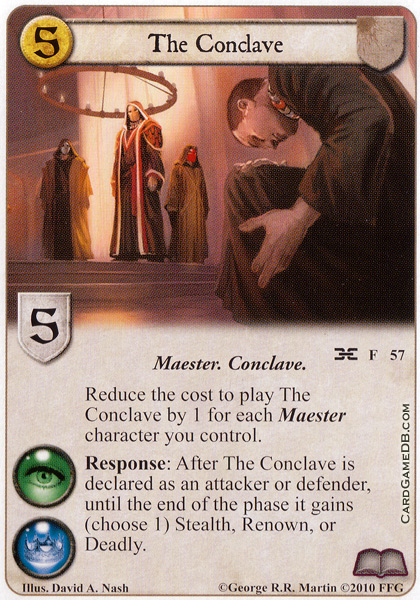
I'm using the big image because this card's impact is still MASSIVE!
After marshaling I was in for a surprise. Unfortunately for me, I was not going to be able to win an intrigue challenge. The Baratheon player was an easy target but was supported by a Targ Summer deck that had Daenerys Targaryen (GotC) and The Long Summer (ACoS) to form a massive 24 Intrigue Strength. Meanwhile the Melee on Arrogant Contender (LotR) would push the Lannister player over the top.
I had to throw my intrigue challenge at the Lannister player just to force him to kneel most of his forces. Then I pushed the power challenge through with renown on the Conclaves and Leyton to get to 13 power. (Lanni had no power on his house card
 ).
).At this point the other three players were openly discussing how to work together to keep me from winning. They were out of reset plots, so they needed a way to direct kill both Leyton Hightower and my Informed Acolyte with Taste for Blood.
The Lannister player said "he could help" and the Targaryen players said, "I've got something." So I knew this was going to be close.
I took the next action window to kneel Lomys and discard a power from Leyton to make him "cannot be killed," but Lannister canceled the ability with The Iron Throne (LotR).
Lanni then convinced Bara to attack him with his only Intrigue character. Lanni won by 4 and used Terminal Schemes (LotR) to kill Leyton. Lanni then convinced Bara that he should not attack me for military even though he had 2 claim. Instead he attacked me for power and I redirected it. Lanni let it go through unopposed and Bara moved up to 12 power.
However, the Lannister ravens advising avoiding military conflict must have not reached House Targaryen in time.
For claim I killed Quentyn Martell (TGF) to move to 14 power.
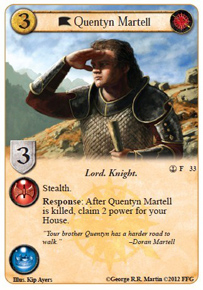
Good night sweet prince!
Targ responded with Die by the Sword (LoW) on the Maester, then I triggered Taste for Blood while the card was in moribund to reach 15 power.
(I'm sure you guys will correct us if that's not the proper timing, but after discussing it and looking at examples of moribund responses it seemed valid to us
 ).
).Anyway, that's how thats how a bunch of unchained Maesters won the crown for Dorne and House Martell in...
A Game of Thrones!
- biggs369 likes this


12 Comments
The theory of card relativity is interesting but it ignores the support/oppose factor that is ignored from the melee titles. The Whispers title has the added benefit of 2 opposing titles, MIL the redirect/pull ability and the Regent the redirect ability. Though I suppose you could argue that those are opportunity costs in and of themselves since you are giving up the capacity to be supported, support, or oppose other players - so maybe that additional stuff is negligible.
Anyways, nice melee report and glad to see Martell/Dorne is working out for you!
It works for the title because you either choose +2G in perpetuity or +1C in perpetuity. The same is not the case for GTM.
I appreciate attempting to determine costs quantitatively, though. It's one thing I have always had difficulty doing.
If you pick the redirect, sure you can protect yourself from 1 challenge from 1 person, but if you picked a title that was supported by someone you could protect yourself from 3 challenges from 1 person. It also gives you the potential to oppose someone for a chance at gaining additional power. And you have the potential to be supported by a player as well. But you also risk supporting someone that you would rather be able to attack. And being a target from the person that opposes you. All opportunity costs. So I can understand taking the bonuses at face value and saying they are all equal. At least it gives us SOME kind of baseline to compare things.
That may be, but that still doesn't change that there is a large difference between "+3 STR in a Mil challenge" and "adding +3 to your total STR in every Mil challenge in which you have a participating character".
Deliberately ignoring the entire support/oppose/redirect mechanic as "opportunity costs", all of which are just assumed to be equal and can hence be written off is absurd. Especially since in most melee games, that part of the mechanic is more important than the flat bonuses themselves.
Also, there is an underlying assumption that all of the bonuses on the melee board are equal and balanced. The author looks at the different titles and claims that Fantasy Flight's intention was to have the effect of each be roughly equal, and then extrapolates the rest of his theory based on that. I don't see anything to support that this is true, other than the fact he assumes it to be.
Given the importance of initiative and the layers of strategy associated with picking the first player in a four person melee game, I am more likely to assume that the titles do not give equal bonuses. That some titles are almost always the best, some are situational, and the last few are just typically poor choices that the last player is forced to pick from.
You can't make the claim "2 Gold = 1 Card = 2 Influence" based on the melee board unless you buy into the entirely unsupported assumption that every title was designed to be perfectly balanced with every other one so that every player ended up with something equally valuable no matter when in the order they got to pick, as well as write off every other mechanic on the board as "more or less working out to equal anyway".
I don't believe the titles are really that unequal, except that influence seems the most situational. Historically, the titles were created during the CCG, at a time when each House had influence-based effects (due to the fact that gold existed only during marshalling). However, the support/oppose mechanic is a very important factor in the choice of titles; in 3-player games, it can even be the deciding factor when there are only 3 titles left.
I agree 100%. The support/oppose/redirect abilities are not only extremely variable in the advantage they grant, but they are also highly unpredictable in how other players will use them. While "oppose" is straightforward, the use or disuse of support and redirect effects are often chaotic. While a player may have the opportunity to participate in a challenge via a support/redirect mechanic, often he/she will choose not to do so.
For that reason I don't think this theory is ready to quantify those abilities.
You're right on about GTM: it is more complex than 2g=1c. However, I expect you'll find the analysis of GTM within the Theory of Relativity of Card Effects thread a more accurate/thorough representation.
Also, thanks for the encouragement. This is a big project, but I'm hopeful that it'll be a valuable tool for the AGOT community.
Burke's analysis in particular is fascinating: his numbers produce a % likelihood for given team to win based on the score, down, and distance, and field position. Burke's ideas are already revolutionizing some aspects of the game. Statistically, he's proven that punting on 4th and short drastically decreases your chances of winning. Coaches like Gus Malzahn of Auburn and Chip Kelly of Philadelphia both embrace the "go for it on 4th and short" revolution and it payed off for the Eagles big time this week.
Admittedly, AGoT doesn't have the luxury to have every melee game transcribed into play-by-play for later analysis of turn order, title, score, and board position. Yet, because the number of cards and what they do is finite, I do believe we can really make some useful correlations.
It's true that there is a difference. For a concrete example let's look at the Kingsguard title.
The Kingsguard Title's +3 to all Military challenges seems stronger when you can marshall 3 characters with a Mil icon than when you can marshall only 1. 3 Mil icon characters would give you more potential to win a Mil challenge as an attacker, defender, and use the redirect. This is effectively +9 which is better than + 3 Strength in a single Mil challenge. By extension, the title has less advantage when you have 0 military icons since it is then + 0.
The heart of your 2nd point is that I might select the Kingsguard regardless of it's Mil value because the following privileges are too powerful to be ignored:
- to block another player from getting it
- to allow me to attack any another player
- so that no player would oppose me
- to redirect an unopposed military challenge to myself and steal a power if I won that challenge as the defender
Those are all powerful aspects of the Kingsguard title, but don't you think that they are all highly situational? If they provide only situational value, do you have a proposal for how to quantify them? I'd love to incorporate the support/oppose/redirect mechanic's value into the theory if you have a suggestion.If we are able to prove they are not equal, then we could possibly prove that one is the best. To me, knowing which title or titles are the best doesn't make the game less fun. Getting the best possible title just give players another thing to compete over.
That's fair. I certainly don't have any inside information about AGoT's design mechanics.
In Mary Shelly's "Frankenstein" a sailor sets out to find the Northwest passage and the mysterious "power that pulls the needle" of his compass. The more I play this game, the more I feel that the game is shaped by the invisible ratios of costs and effects. I feel like I've seen the needle move, and I feel the power that moves the needle can be discovered, documented, and understood. Since many might say the AGoT cost/benefit needle is in a haystack, I've grabbed a pitchfork. I wanted to share this theory, since I think it will get stronger if it addresses feedback like the items you've mentioned.
I'll admit this is a theory (which is subject to being disproven like any theory). There may not be any consistent underpinning to AGoT. But if the applied intellect of mankind can translate hieroglyphics, I feel like quantifying AGoT effects is pretty doable.
Valar Dohaeris.
It was a hard choice to take out the black ravens. I chose to drop them to help the deck deliver consistently huge setups. I don't miss the extra cards since my basic plan is to vomit cards onto the board until I only have 1 or 2 cards in hand then NatGS.
I think this deck could easily take a summer turn and add a couple black ravens, Open Market (ASoS), and Shores of the Summer Sea (AToTT), to see Citadel Law, The Viper's Rage, etc. over and over again.