
 Card Game DB

 Sign In
 Create Account
Welcome to Card Game DB
Register now to gain access to all of our features. Once registered and logged in, you will be able to create topics, post replies to existing threads, give reputation to your fellow members, get your own private messenger, post status updates, manage your profile and so much more. If you already have an account, login here - otherwise create an account for free today!
Register now to gain access to all of our features. Once registered and logged in, you will be able to create topics, post replies to existing threads, give reputation to your fellow members, get your own private messenger, post status updates, manage your profile and so much more. If you already have an account, login here - otherwise create an account for free today!
 0
0

The Grand Melee - Competitive Play
Jul 11 2013 05:05 AM |
emptyrepublic
in Game of Thrones
Small Council The Grand Melee emptyrepublic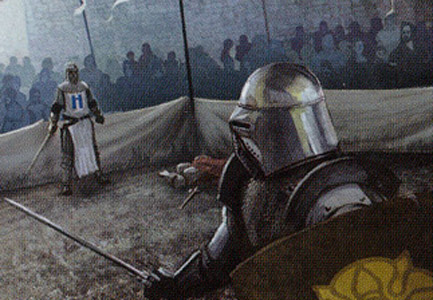 Welcome to The Grand Melee! I’m emptyrepublic and you might know me from the forums or from the CardGameDB series Scheming on the Sands. I’m making a move to The Grand Melee as I’m looking to try something different and because it’s the format I generally play the most. It’s also the thing that really hooked me on the GoT: LCG. So from time to time you’ll see me here with bigfomlof and possibly a few others. Anyway, enough about me, let’s get to this week’s topic.
Competitive Melee
We’ll keep it simple this week as we continue this long running series. So let’s talk about competitive melee or―more specifically―why joust is generally considered the “higher†format for competitive play and melee the secondary. We’ll break down the problems first and then theorize on some solutions.
The Problems
Here are some thoughts on why people don't generally like competitive melee; some of which you may have heard before especially if you frequent the forums on this site or FFG’s site. The list isn't exhaustive, but is a short list of complaints that can be found in the usual GoT communities online.
Problems with Competitive Melee
- Game dynamics too unpredictable or volatile.
- Don’t enjoy table politics.
- Too much “psychology†involved.
- Prone to abuse by colluding players.
Unpredictable Game Dynamics
Concerns about game dynamics being too unpredictable or volatile can mean various things but most simply it comes down to the fact that with four players in a game card interactions can get bizarre. Additionally, the burden on the competitive player is higher because they have to constantly evaluate the board to try and anticipate potential threats and combos. This is clearly much more of a challenge in a four player game than a two player one. Finally, with four different decks in play the probability of unintended consequences will go up as plots are revealed and events are played and a seemingly innocuous plot might turn out to be disastrous.
In Joust there is no table politicking because there is nothing to negotiate over. There has to be a winner and a loser. You do everything you can to be the winner and the other person the loser. In Melee you can increase your chances of winning if you can convince someone to at least enter some truce for a few turns. If you are sufficiently charismatic you could potentially pull off a coup by convincing someone to take out a larger threat while you slow plan to take out your ally. Many people don't like this. Either because the introduction of a meta-dynamic muddles the actual game dynamics or just simply because they've been the victim of such a tactic.
There also the issue of “Kingmakingâ€. Kingmaking essentially the act of a player who has determined that if they can no longer win to instead deliberately act in order to enable another player to win. To be clear, this is not player collusion. This is simply someone who began the game with the full intent to win themselves, but later on determined that for their advantage―or simply to spite another player―they would throw their lot behind another player if they could not win themselves.
“Psychologyâ€
This ties in partially with the table politics portion in that to work the table politics you need a bit of a grasp of the psychology that’s going on among the players. While Melee format GoT is not the same as Poker there is a large element of psychology that comes into play that is the corner stone of Poker. This is reflected a few ways. First, understanding how your opponent things. If it’s someone you know you might have a reasonable edge in predicting how they would react in certain situations or how what tactic they use. This would often be the case in stable metas where the same base of players play each other regularly.
Colluding Players
To be clear, this is distinct from table politics. In essence player collusion is cheating, plain and simple. There were a few incidents in the past during competitive tournaments where this became a bit of a problem. There’s been controversy regarding what constitutes cheating and so on. Thankfully, Fantasy Flight recognized the problem and have recently addressed the issue by updating tournament rules to provide organizers a framework on how to handle future collusion and cheating. Unfortunately though that doesn't mean it can't happen again and it’s entirely understandable if someone prefers to not get into a situation where they are a victim of collusion when the tournament organizer did not or could not resolve the issue.
In joust all of these problems are essentially non-existent except for unpredictable game dynamics; joust dynamics are not as erratic as they can be in melee. So it’s easy to see why people prefer joust as a competitive format.
Solutions?
So some of the most salient problems with competitive melee have been laid out; is there anything that can be done?
Unfortunately not much. The problem stems from the simple fact that most of the things that people take issue with are not mechanical.
First off, would anyone want the game to be less dynamic? Complaints are already abound regarding new tech like The Long Voyage (TPoL) making the meta stale or uninteresting. Most GoT players seem interested in a vibrant meta with shifting archetypes and distinct lines between the various houses; not moving the game to state where everything feels and operates the same.
Table politics and psychology are entirely disconnected from the game mechanic and stem from meta behavior that is dependent on the personalities and egos of those participating in the game. Opinions of table politicking and player psychoanalysis is likely based entirely on one’s experience with other players and the ability/desire to engage with people outside the mechanics themselves. The simple fact is that some people like this and other people don’t. How one stands on this probably determines their position on melee.
Regarding player collusion, as mentioned before Fantasy Flight has already taken some significant steps to address this. In the official A Game of Thrones Tournament Rules they've gone to great lengths to outline what qualifies as collusion and addressed it directly as cheating.
What do you think?
Melee is present in most major tournaments so it’s not at risk, but when it comes to discussion about competitive play the focus is mostly on Joust. What are your ideas to bring Melee on par with Joust? Are the meta aspects too difficult to overcome or is there a solution that people just haven’t found yet?
- bigfomlof, Kennit, MotoBuzzsawMF and 2 others like this


14 Comments
I actually find this argument a little funny. As, generally speaking, everyone is trying to win - everyone is a true threat. I could also argue that, especially with game politics involved, that there is no way to "make no mistakes" in a game. If you had won any of those games were a "scrub" couldn't see the real threat - couldn't your opponents make the same complaint? Most of our melees are won by someone who doesn't look like the "immediate" threat but then closes out the game on a turn.
Anyways, I personally really enjoy melee - but I do agree that not every game is enjoyable, it can take a long time, and it does suck when you are the weakest link and are farmed for power. After my experience at Worlds last year I can completely understand peoples distaste for melee in a competitive format however.
Anywho, I love melee and I would love to see it come back from being the annoying little brother in tournaments.
P.S. I am part of the resistance to "The Long Voyage" and refuse to play it.
There's an argument that you've therefore not made meta-game decisions incorrectly or not been persuasive enough but some people don't consider that as a skill in the same way as the in-game decisions. In some games like diplomacy or game of thrones the board game your expectation is that you're partly being evaluated on your ability to convince. Whether people want that to be part of Game of Thrones the card game may afect whether they like Melee.
- Don’t enjoy table politics.
- Too much “psychology†involved.
- Prone to abuse by colluding players."
You just described The Game of Thrones.
Personally I love melee and the politics of it has allowed an otherwise average player like myself to gently push for victory, against technically better players who looked a lot stronger out the starting cages.
That saying the random element of people will never sit well with some types of players.