
 Card Game DB

 Sign In
 Create Account
Welcome to Card Game DB
Register now to gain access to all of our features. Once registered and logged in, you will be able to create topics, post replies to existing threads, give reputation to your fellow members, get your own private messenger, post status updates, manage your profile and so much more. If you already have an account, login here - otherwise create an account for free today!
Register now to gain access to all of our features. Once registered and logged in, you will be able to create topics, post replies to existing threads, give reputation to your fellow members, get your own private messenger, post status updates, manage your profile and so much more. If you already have an account, login here - otherwise create an account for free today!
 2
2

The Grand Melee - Psych 101
Oct 11 2012 05:00 AM |
bigfomlof
in Game of Thrones
Small Council The Grand Melee bigfomlof First, I'd like to thank the Small Council for the opportunity to write a column for The Grand Melee, a series I have followed religiously since it appeared. Since this is my first article on the site, I'll take a few moments to introduce myself and detail my experience with the game. I have been playing Thrones for almost three years, mostly melee, in a small meta (can I call it that?) of 5 or so other friends. None of us plays competitively, nor are we the types of players who would enjoy that format and its intensity. We are casual melee-ers and first became entranced by this game for thematic reasons. We're all avid fans of the books and know them well, and so we began as a very Nedly group, building decks more for the thematic possibilities than to win anything. Fortunately, we have grown up since then, and though theme is still the central reason we meet almost every Tuesday, we like the feeling that comes with a well-built, competitive melee deck.
This series of articles will be about the psychological aspects of the melee experience. Though I'm a casual player I hope that more knowledgeable and competitive players will get something out of the idea that the melee game is as much about negotiations, fear, and promises as it is about marshaling beast characters and setting up awesome combos. The psychological impact of a card on the table can't be overlooked, to be sure, but the best cards come with the possibility of hidden strategies and backstabbing, ruinous behavior. Now, my group may be an exception here, and I'm certain that we respond to certain cards differently from other metas and players, but what goes on between the cards in a melee format fascinates me to no end.
Let's start with the Treaty Agendas (Treaty with the Isles (CoS), Treaty with the North (LoW), Treaty with the South (CoS)). Right away, the first thing you notice is that you just made the game 33% easier to win for everyone else yet upside is the ability to make a dual-house deck viable and cost-effective. The possibilities for that type of deck-building are limitless, really, so that makes the Agenda fun in its own right. There are some who believe, and rightly for the right style of deck, that these Agendas are good options in Joust, but the general consensus here is that these cards are a big, whopping waste (just look at the forum thread "Most Useless Cards" and see what pops up first). In any case, this article will not tackle how these Agendas work in Joust (though I hope one will soon, since I'd like to learn about it) for the point under discussion here is what this card does to the table's psychology. If I plop a card down that takes the win condition to 10 Power for three players, they're all aware of that, and this has two immediate positives, in my estimation. One, the other three players are more likely to attack each other than me, since I need 5 more Power than anyone else to win, and two, things tend to slow down a bit with the other 3 players and cat-and-mousing each other all over the place. So, three turns under the radar later, my Holy Rollers deck (a holy Greyjoy/Asshai deck which really sucks when I look more closely at it) suddenly emerges with 8 Power and a shot at winning on the next Power of Faith turn. The Titles help immensely, and just when the other 3 think they have you cornered, you force an alliance with one of them, garnering their support. There are probably other ways in which the Treaties manifest themselves on the psyches of those playing around you, but these were the first 2 upsides I thought of when I built the deck. That said, the fact that hardly anyone uses them most likely indicates I'm missing something, but I loved what it did to my group.
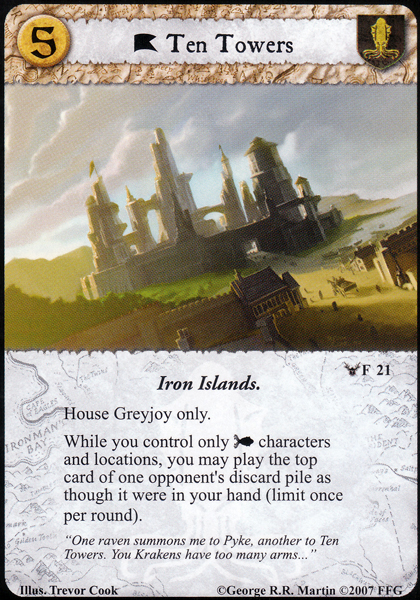
Next, Ten Towers (AE), a stupidly expensive card with a situational use that can only be triggered once a round. At best, for the cost of 5 gold you may get 3 uses out of it. So, what conceivable effect can this have on the other players? Well, this is one those cards that makes the most out of the negotiating aspect of melee, and the reason that melee is my favorite format--it's all about the talking, the give-and-take of lies, deceit and meanness. I use the card in one deck, and if I don't get it in my opening hand then I don't use it. If I do, it's my only drop (I know, I know--there's a ton of attendant issues with that) and my first plot becomes The First Snow of Winter (ODG). And then Ten Towers sits there from the beginning, a looming possible threat in the distance. It goes like this: all those decks that love their events so much now have something to think about when they use them. I could Die by the Sword (LoW) right back at you if the timing's right (and I can always threaten that anyway) for example, or start to own all that stuff my Mill deck threw in your discards. Sometimes, it's best on negotiations. For instance, say it's time to gang up on the Martells, and he's the last player in the round. I'll say to Stark (for example), "Hey, if you nail him and Price of War him I'll do the same thing with my attack." Sure, the Martells hear it coming but so what--the very threat of it alters how they think about the round and their turns.
These are but a few short examples of cards that have a psychological impact on my table. Feel free to add cards that change your table, too, or suggest some that I should look at for later articles.
Thanks for reading.
- thedaffodilfish likes this


17 Comments
Perhaps my view on the game is not as complete as others but I think FFG really did those agendas a disservice with the downside they gave them. I think the Treaty agendas would see more life if there were like the North agendas and only raised your power limit to win as opposed to lowering everyone else's.
I prefer to look out for cards like Scouting Vessel (KotS), Longship Black Wind (CbtC), Frozen Outpost (LoW), Wintertime Marauders (ACoS) or Naval Escort (ASitD) to interfere in a challenge or the game.
In a good way?
O, when you say "look out for", what do you mean exactly? Do they fundamentally change your approach to that melee? That's what I'm shooting for in these articles, really: What cards freak you out when you see them so that you shift your whole set of tactics and can't get its possibilities out of your head?
Also both treaties and and ten towers guarantee you're not winning in Melee, that is if anyone is running something rushy, or just generally know what they're doing. In my experience that is, while i love deckbuilding, the jaime in me prevents me from messing around with treaties and cards such as ten towers.
Basically, if you have a Treaty deck, I think you better be able to either stop the opponent's ability to grab that power or you need to have the ability to steal power from them quite often so you can keep them at bay.
My meta also has a very strong aversion to Melisandre. Both core and RotO versions. Also, non-kneeling characters are always targets. We also hate kneel decks. So if someone playing lanni drops out a Lannisport Brothel (Core) and/or Castellan of the Rock (BoRF), we pretty much gang up on him/her and beat them into the ground before moving on to trying to win.
If you're looking for cards which really screw people over, and force change of tactics, I'd suggest
The Red Queen's Faithful (CD) with it's ability to move power from house to characters. That can really screw over timing of resets, or plant a big target on a character that you now suddenly want to keep alive. Also, you can choose the player, they don't have to have participated in the challenge, making it even more effective.
King Robert's Host (TWot5K)
Melisandre (RoR)
Melisandre (Core)
Melisandre (RotO)
The Red Queen's Faithful (CD)
Are some big ones for Baratheon. They all really force your opponent to think really hard about the way they play (unopposed rush Mel for example,) or completely lock down an aspect of the game. (Renown Mel, KR Host.)
Yes, it makes you a huge target, but there are ways around it.... ;D
Maester Lomys (CbtC) with The Red Queen's Faithful (CD)
is one of the crazy ones I've been messing with. If you feel valar coming (after moving power to your key guys) use Lomys so they cannot be killed. The three or four power lost isn't huge. (I always have back up paper shield or outwit with a learned char out too. Just use outwit one turn, then valar or wildfire yourself once they're a problem.)
I really want ff to focus on baratheon "spending" power for stuff like lomys' effect. They rush hard enough that they can afford it (or so you think till someone snipes a win from you, but high risk high reward seems to be Baratheons wheelhouse, so its cool.)
Now you have my secret planssss!
Maybe that´s not the correct translation (I´m German). I wanted to point out that there are other cards with a higher ("psychological") impact since they are cheap, easy to use and not limited. The cards I mentioned are often underated in melee games because the are not constrained to you and another player in a challenge.
I would add Greatjon Umber (WLL) as a melee jumper to this topic - specially if he is equipped with Ice (Core).