
 Card Game DB

 Sign In
 Create Account
Welcome to Card Game DB
Register now to gain access to all of our features. Once registered and logged in, you will be able to create topics, post replies to existing threads, give reputation to your fellow members, get your own private messenger, post status updates, manage your profile and so much more. If you already have an account, login here - otherwise create an account for free today!
Register now to gain access to all of our features. Once registered and logged in, you will be able to create topics, post replies to existing threads, give reputation to your fellow members, get your own private messenger, post status updates, manage your profile and so much more. If you already have an account, login here - otherwise create an account for free today!
 0
0

Wars Are Won With Quills - Houses of the Holy
Nov 27 2013 06:10 AM |
Reldan
in Game of Thrones
Small Council Wars Are Won With Quills Reldan Welcome back to another edition of Wars Are Won With Quills, where we discuss the finer points of deckbuilding. Today’s article is going to focus on the practical application of deckbuilding theory by taking a look at a deck that could not have worked at all prior to the release of the last couple packs. Neutral Faction Holy Kingsguard TLV! That’s a mouthful, so I’m just going to call the deck Houses of the Holy. Houses of the Holy is a deck that can work extremely well though it’s not without a flaw or two. It may not be a top tier deck but it’s definitely powerful and it definitely breaks the mold of what you expect an AGOT deck to look like.
Before we get to talking about the deck itself, I want to discuss a bit about the components that make up the deck and why it works now but wouldn’t have before, even though a lot of the cards in the deck have been around for a while.
The Song Remains the Same - The Troubles and Travails of Neutral Faction
I love Neutral Faction and have for years; I even played Neutral Faction during both the 2012 Gencon Joust and the 2012 Gencon Melee. A Neutral Faction deck doesn’t look like any other House-centric deck. The idea of a deck that’s not constrained to the established archetypes for each of the houses just seems liberating to me. With that said, Neutral Faction decks do provide a number of challenges to the deckbuilder that you’d never encounter anywhere else. The list of things you lose by going Neutral Faction is pretty hefty, so here are the highlights.
1) No access to House X Only cards. Most houses have access to handful of house-specific cards that are particularly efficient. We won’t be able to use any of these.
2) Characters cost more. Neutral Faction only reduces the gold penalty of OOH characters by 1, meaning all non-neutral characters cost 1 more than they normally would.
3) Attachments and locations cost way more. Neutral Faction doesn’t help you cover the cost of non-neutral attachments and locations at all.
4) Resource locations are rather limited. You don’t get to make use of the seas or fiefdoms or any chambers cards. Even Kingdom of Shadows is denied you for being all-factions instead of true neutral.
However, when a Neutral Faction deck works, given the disadvantages I just listed, then it’s doubly satisfying. Further, there are a few benefits to playing Neutral Factions that a savvy deckbuilder can take advantage of.
1) The Long Voyage. It’s sometimes forgotten but FFG didn’t actually ban or restrict this card. If you can handle going neutral, you still have access to this agenda, and it’s still as good as it ever was since they never nerfed the effect in the slightest.
2) Exploration of cross-faction themes. There are some cycles or themes in AGoT that provide incredible efficiency if you play along, but which simply don’t have quite enough support in any single house to truly build a deck around. The old cycle of Kings and Queens and their uber-powerful discount armies from the first CP is one such. Holy is another (more on this below).
3) Hollow Hill. Draw a card as a free, unlimited response anytime you play a character from a faction you don’t already have in play on a 1-gold location? This is one of the best albeit hardest to use card-drawing engines in the game. However, Neutral Faction is pretty much much built to take advantage of this.
4) Play vs. Put into Play. The best way to deal with the gold penalty of playing Neutral Faction is to simply work around paying it in the first place. It only applies to cards played out of your hand - if you have alternate means to get cards into play, then the “drawback†for playing Neutral doesn’t apply at all.
Over the Hills and Far Away - The Holy Subtheme
I’ve always felt like the designers at FFG have no idea where they’re going with the Holy crest. They’ll print some really strong cards that make use of Holy, but they haven’t given any one house a complete set of efficient holy characters to work with. Baratheon, Greyjoy, and Lannister have all been getting bits and pieces of the Holy jigsaw puzzle, but no one house has it all. It is in many ways similar to Baratheon Knights decks which have always had a problem with not having enough great Knight characters in-house to fully flesh out the theme, and the resulting decks were always weaker for having to run mediocre Knights to supplement the all-stars.
Thankfully, Holy cards have by-and-large been written to use and benefit Holy characters in general, without restriction by house. Neutral Faction can take advantage of this and have the Drowned God, R’hllor, and the Seven all working together to bring their combined divine smackdown upon the non-believers.
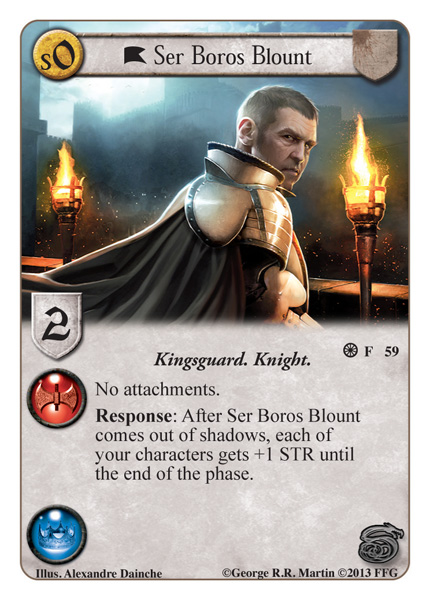
The Kingsguard! Finally a fully fleshed out theme that actually works for neutral! As somebody who’s been playing Neutral Faction decks for a long time, you cannot even understand how happy I am to see them finally create a true cycle of efficient characters and plots that are entirely neutral, synergize, and are not simply filling in the gaps around house-based themes. The last time they did anything like this was the Brotherhood cycle, but the restrictions you had to comply with to make those cards work was too harsh, and even then you only had 3-4 actually good characters to work with.
The Ocean - The Logistics of Taking Long Voyages
When the FAQ came out earlier this year making TLV be Neutral Faction Only I laughed so hard I almost cried. The problem with Neutral Faction TLV at the time was that FFG never printed enough neutral resource locations to actually make such a deck work! A normal 60-card deck usually runs 10 or so locations - typically 3x of the 0-cost gold producer, 3x Seas, and 3-4 of the 1-per-deck Streets. If you bump up to 85 cards for TLV, then you need to increase your resource location count up accordingly to around 15. The joke is that Neutral Faction doesn’t actually have access to 15 resource locations. Once you get past Roseroad and Searoad and the Streets you have have maybe 10-11 - this isn’t enough to run a such a deck off of. The miracle of miracles was the printing of the new Kingsroad locations from FoI as truly neutral location and not as all-faction locations like Kingdom of Shadows. With three of these in the mix, Neutral TLV starts to become viable.
So, with all that said, let’s turn our attention to the deck itself.
Houses of the Holy
Total Cards: (85)
House:
Neutral Faction
Agenda: (1)
1x The Long Voyage (TPoL)
Plot: (7)
1x Alliance (PotS)
1x Valar Morghulis (Core)
1x Search and Detain (HtS)
1x City of Lies (CoS)
1x Many Powers Long Asleep (RoR)
1x A Song of Summer (ASoS)
1x On My Oath (TK)
Character: (47)
3x Aeron Damphair (KotS)
2x Doubting Septa (LotR)
3x Practical Believer (CtB)
1x Septa Mordane (AToT)
2x Ser Lancel Lannister (TPoL)
3x Shadow Enchantress (OSaS)
1x Shireen Baratheon (FtC)
1x Zealot of the Light (BtW)
3x Knight of Summerhall (DB)
2x Pyromancer's Apprentice (TBoBB)
1x Syrio Forel (TftRK)
1x Varys (SaS)
3x Carrion Bird (ASoS)
2x Samwell Tarly (TRS)
3x Ser Jaime Lannister (TK)
1x Ser Meryn Trant (TK)
3x Ser Mandon Moore (TK)
3x Ser Preston Greenfield (TK)
2x Ser Boros Blount (TK)
1x Ser Arys Oakheart (TK)
3x Melisandre (TK)
Attachment: (2)
2x Black Raven (ASoS)
Event: (13)
3x Confession (KotS)
2x Judged by the Father (TCC)
3x Nightmares (LoW)
2x Paper Shield (QoD)
2x Supported by the Smith (AJE)
1x Condemned by the Council (AToT)
Location: (23)
1x Flea Bottom (TGM)
3x Hollow Hill (ASoSilence)
1x River Row (QoD)
1x Shadowblack Lane (Core)
1x Street of Silk (LotR)
1x Street of Sisters (Core)
3x The Roseroad (KotStorm)
3x The Searoad (KotStorm)
3x The Iron Mines (KotS)
3x Pentoshi Manor (AHM)
3x The Kingsroad 29 (FaI)
The Kingsguard, when working together, are monsters on the table. They are all efficiently priced for their STR and keywords, and the abilities range from good to great. Ser Jaime Lannister provides supplemental card draw that should easily get you to the draw cap every turn he’s out (since you already are getting an extra draw off TLV). Ser Mandon Moore’s passive “no saves†ability is a wrecking ball against aggro decks that are relying upon saves to get them through a Valar, and the rest of the gang provide a solid wall of useful abilities and strong bodies.
The Holy side of the deck takes advantage of Neutral Faction to bring together the cream of the crop of Holy crests across all the houses. Each house kicks in their best Holy characters, and Aeron Damphair and the new Melisandre lead the way. Aeron Damphair’s ability to go grab and 3-cost or less Holy non-unique when he dies is okay in a GJ deck, but it takes on a whole new level when he can go grab the 3-cost non-uniques from House Baratheon. New Melisandre is just ridiculous, providing free recursion and dominance pumps that work off of half the characters in the deck. The plethora of Holy also enables the deck to run both Confession and Prayer cards with ease, and being able to run Iron Mines with Supported by the Smith is a wondrous thing.
Final Analysis:
So how does this deck answer the questions from my first article? Let’s find out.
Question 1. What are the plans to consistently get extra cards into hand?
This one is easy as pie. TLV is solid as a rock for card draw. On top of that we’ve got Hollow Hill, Ser Jaime Lannister, and Samwell Tarly plus ravens. We should have no trouble hitting cap pretty much all game long.
Question 2. What does a winning game with the deck look like?
The ideal game will involve wiping your opponent’s board with Valar thanks to Ser Mandon Moore turning off all their saves. You’ll aim to strip key cards out of their hands with Confession, get card advantage over them, and take advantage of Melisandre and Aeron Damphair to get and keep a full set of Holy characters on the board, ideally giving you control over challenges as the game progresses.
Question 3. What is your answer to Valar Morghulis?
Recursion and saves. You’ve got Iron Mines and plenty of copies of your main characters to provide dupes. Half of your characters don’t even care if they die, because they can come back from your dead pile straight into play or can replace themselves automatically. You’ve got two plots that straight up do this with On My Oath and Many Power Long Asleep. On top of all this, you’ll almost always have a few characters in Shadows that can easily jump out after a Valar to quickly reestablish board control.
Question 4. Is the gold curve manageable?
This is the hardest question to answer with this deck. The reality is that Neutral Faction TLV still could really use one or two more efficient resources to bump the count of resources closer to 18-20. Once the deck gets going you should be bringing a good number of characters into play without having to “play†them directly, but getting resources on the table the first couple turns is key to getting the engine going. This is the weakpoint of the deck, but it’s a weakpoint that will be fixed if FFG prints another “Kingsroad†type of card or, more ideally, some sort of neutral Holy reducer.
Question 5. What does the deck excel at doing?
This deck draws lots of cards and has incredible tenacity once it gets some of it’s major characters on the board. Nobody that dies stays dead, and that allows the deck’s plots to be obscenely efficient. Many Powers Long Asleep grabbing Melisandre back from death makes it equivalent to an 8/5/1 plot that draws you a card outside of cap. On My Oath getting any Kingsguard character back to Shadows makes it like a 5/7/1 plot that draws you a card outside of cap. You draw a lot and establish a board presence that sticks around through just about anything your opponent can throw at you.
Question 6. What doesn't your deck handle very well and how prevalent is that in the meta?
I’d say the biggest problem is going to be choke, because the first couple turns are make-or-break for getting your key characters onto the table (once they’re out, you can mostly recur them without having to pay for them again). However, if you get a bad setup and choke gets a good setup, you’re going to have a hard time. The solution is, as I mentioned above, having Neutral Faction get just a few more solid resources under it’s belt in future CPs. I’m not sure how strong of a presence choke is going to have right now though, because it honestly has not made that much of a showing at any major tournament.
Conclusion
So there you have it, a Neutral Faction TLV deck finally given the tools it needs to function after all this time. I do not think this is a top tier deck because I think the resources are still a bit too shaky. When it works, it works extremely well, but it’s a deck that needs you to have at least a decent setup in order to make those first two turns count. However, I think this sort of build showcases what Neutral Faction might be capable of in the future. If they print another Kingdom of Shadows type of card but make it True Neutral, I think this will be heavily worth revisiting, and any new good Holy-oriented cards they print (regardless of faction) can only help this sort of deck out.
- wildefox, Sligui, jme and 1 other like this


14 Comments
Always wanted to make a holy-deck work somehow, but always encountered the problems you mentioned. Holy guys are too much spread over the houses. I always tried to work around that with the Treaty- or Alliance-Agenda, but both gave too much of an advantage to the opponents to make the deck really shine, though the deck itselfs had really great synergies going. So I think, neutral faction might be worth a shot, although the goldcurve might really be a problem, as most holy guys are some what really expensive. And I was wondering, why no Power of Faith? Not enough place in the plot deck for at least one copy? Even if you don't rush with your deck, this plot is too good to be left behind. Also missing the neutral holys, High Septon, the Army and Thoros.
So long
I've gotta ask though - why no Twilight Market (AToT)? It's neutral economy and it should work pretty well in this deck, what with all the shadows. In an 85 card deck I reckon you can get away with a couple more limiteds. Seems like an auto-include to me.
Seriously, great stuff. Question: wouldn't Power of Faith be useful here?
Not counting dupes there are only 7 shadows cards with cost S1 or above - I'm not sure that's enough to warrant Twilight Market really.
Twilight Market reduces the cost of putting a card into shadows from your hand, not taking it out of shadows, so it works on all of the shadows cards in the deck.
Twilight Market - The problem is that it's Limited and you already have City of Lies to get the shadow cards in your hand the first turn or two out. It doesn't reliably provide the resources your need the first two turns when you need them most.
Power of Faith - Great plot. This deck started life with 2 copies, and they got bumped, quite frankly, for plots that provided more gold because resources are more of a problem than winning challenges. If another playable resource or two gets printed, this plot is totally going back in.
Other Holy Chars - Not good enough/too expensive, bad traits, and/or because neutral chars don't trigger Hollow Hill. If you have a particular favorite, however, feel free to sub them in - you do have 85 cards to work with.
Longship Golden Storm has the same cost issue and is really just not necessary.
The neutral army sucks ass. Sorry to be so blunt, but it costs too much, does too little, and is an Ally on top of that. Faceless Man is a consideration, but the problem is that he's a card that works off of a theme without actually contributing to the theme itself. You generally want to run very few of such cards because the important thing is that each additional card played within the theme strengthens all the rest.
My problem with Favored by the Warrior is that it's only a save against being killed, and dealing with kill effects is something this deck can already handle through other means.