
 Card Game DB

 Sign In
 Create Account
Welcome to Card Game DB
Register now to gain access to all of our features. Once registered and logged in, you will be able to create topics, post replies to existing threads, give reputation to your fellow members, get your own private messenger, post status updates, manage your profile and so much more. If you already have an account, login here - otherwise create an account for free today!
Register now to gain access to all of our features. Once registered and logged in, you will be able to create topics, post replies to existing threads, give reputation to your fellow members, get your own private messenger, post status updates, manage your profile and so much more. If you already have an account, login here - otherwise create an account for free today!
 0
0

Crimson and Gold - Post FAQ Meta
Aug 09 2013 06:05 AM |
scantrell24
in Game of Thrones
Small Council Crimson and Gold scantrell24 Lannister FFG knocked Targ and Greyjoy down a peg, and put rush and aggro back in their proper places . Let’s see where House Lannister stands in the aftermath.
No Agenda / Character Agenda
There’s already an excellent discussion on the forums regarding this specific deck, but I’ll review some of the important details here. Ser Kevan Lannister (VM) hit the scene more than a year ago, but didn’t see much play competitively until now, thanks to the release of the missing puzzle piece, House Clegane Brigands (AToTT). In a single character we find high strength, a war crest, the two best icons, and the potential to participate in three challenges per round – in other words, a legitimate reason to forgo an agenda.
As with most Lannister decks, this one focuses on kneel as its primary means of board control. Cersei's Scheme (TPoL), Enemy Informer (Core), Lannisport Brothel (Core) and You've Killed the Wrong Dwarf! (Core) pin down our opponent’s biggest threats and allow for unopposed challenges or victories on defense. Plots like Wildfire Assault (Core), Marched to the Wall (LoW), and Frey Hospitality (LotR) push down the number of opposing characters in play, which helps because the fewer there are, the easier it becomes to kneel them all.
If that tactic proves elusive or ineffective, we’re in trouble. Lannister characters often lack the high strength, stealth and deadly necessary to compete in high-stakes challenges, so we must prevent some opposing characters from participating -- or risk defeat. Lannister can be short on renown and power icons as well, so we have to play the long game, slowly gaining power from unopposed challenges and chipping away at our opponent’s hand. This makes repeatable kneel effects such as Volantis Inn (AHM) and Lannisport Tourney Grounds (ODG) even more valuable than one-off triggers like Distraction (Core).
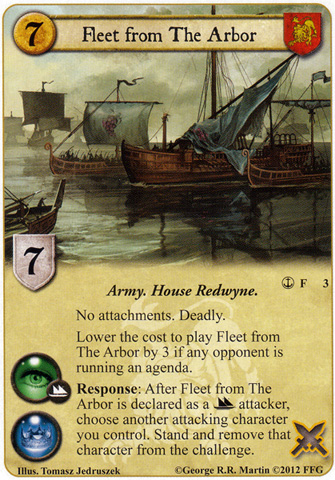
One potential downfall of Kevan Lannister’s ability is that you’ll want to attack first for maximum impact from Kevan, Cersei, Ser Jaime Lannister (TTotH), Shagga Son of Dolf (DB), and Ser Balon Swann (TWH), but kneel decks usually prefer marshalling second to have more targets for Enemy Informer and Enslaved (THoBaW). This deck also tends to have a fairly high gold curve, so you’ll have to run several of the gold-producing chuds like Lannisport Weaponsmith (Core), or some alternative economic boon.
Any of the “big three†Lannister restricted cards are an option here. I run Pyromancer's Cache (TWot5K) myself, but Castellan of the Rock (BoRF) and Pentoshi Manor (AHM) are excellent cards in their own right. Many players avoid the Cache because it’s easier to just run Golden Tooth Mines (Core) and free up that restricted slot. Regardless of your choice, No Agenda is unquestionably one of Lannister's top builds, as evidenced by it's dominant showing at a recent London tournament (3 of the top 4)
Knights of the Hollow Hill
This is another relatively new invention gaining steam lately. Karma on the board started a discussion thread for it where you can find his insights and decklists. Lanni KotHH is similar in some ways to classic kneel, but there’s also a challenge denial element using plots like Lead by Example (ARotD), Desolate Passage (TRS), Shadows and Spiders (LotR), Lineage and Legacy (KotStorm) to alter the regular rules for challenge declaration and defense. In addition, cards like Watchful Servant (CD), Toll Gate (AE), and Walk of Shame (ARotD) can remove characters from a challenge, taking your opponent by surprise and turning the entire challenge phase in your favor.
Now you might be asking yourself where the agenda comes in, but it’s purpose is two-fold. First, without a setup we’re free to run a higher than normal number of control-oriented events like Double Bluff (LotR) and maybe even Restrict and Restrain (MotA). Second, it provides influence for Ser Gregor Clegane (LotR) and Judged by the Father (TCC), among other things. I suppose another advantage is that Lanni KotHH isn’t widely played, so you’ll catch some opponent’s off-guard. Even experienced players will have to stop and read a few of these diamonds in the rough.
Power Behind the Throne
Many different versions of PBtT decks exist, ranging from all-or-nothing rush to more traditional Lannister control, and I won’t recap them all here, but the agenda deserves a mention because it’s fun to play yet still competitive, if a bit risky for my tastes. You can check out the forum thread here.
One of the most difficult decisions stemming from PBtT concerns the restricted card. The aggressive, win-by-turn-3-or-die decks will suffer from the restriction of Asha Greyjoy (WLL), which they ran out-of-house for her renown, intrigue icon, and most importantly, non-kneeling ability. Other options include The Conclave (CbtC), Fear of Winter (BtW), or any of “the big 3†in a control deck.
I will always remember when my OCTGN opponent used King's Pavillion (KotStorm) in combination with non-kneeling characters like Cersei Lannister (LotR) and Littlefinger (SaS) and non-kneeling plots like Game of Thrones (LotR) and Schemes of the Scholar (HtS) to count 8+ strength, trigger Make an Example (PotS) in consecutive turns, and win the game easily on turn 3. It was a sight to behold.
House of Dreams Tunnels of the Red Keep
City of Shadows
House of Dreams with The Iron Throne or Lannisport Brothel
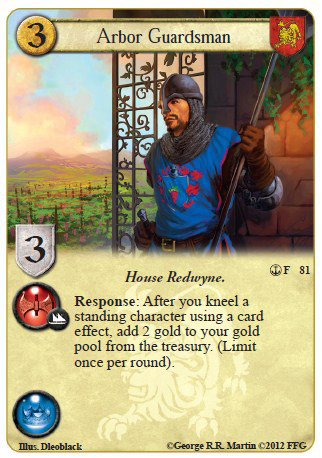
I’m almost convinced that a No Agenda deck with Kevan Lannister is strictly better. They’re essentially the same deck, chock full of efficient Lannister cards, but House Clegane Brigands presents a significant opportunity cost to running House of Dreams. Also, just to clarify, if you want to wait and decide which location to pull after seeing your opponent’s House and Agenda, technically you would have to win a coin flip at the start of the game. In practice though, you’ll rarely that enforced.
Big Money Decks
I don’t know if there’s more support in the next cycle, but right now they’re close. The crux of their combo revolves around Joffrey Baratheon (PotS) and Sitting the Iron Throne (AToTT) to grab power quickly and/or discard multiple opposing characters. I’ve seen a Black Sails deck with Val and Pyre of the False Gods (KotStorm) out-of-house that self-milled with Desperate Measures (TCC) and then recycle events with Blessed by the Maiden (AJE) and locations with Supported by the Smith (AJE), and I’m sure there are other variations out there. Tywin Lannister (LotR) and Daven Lannister (GotC) have been around for a while but they’re just now half-way legitimate options.
Treaty With the Isles
Again, this deck got hit with the Asha Greyjoy restriction, but her other version (Asha Greyjoy (KotS)) is nothing to sneeze at. I’ve gone 4-1 since the FAQ update and if nothing else it’s still fun to play because you have that added tension from the agenda. Pentoshi Manor and Iron Mines are a match made in heaven. Check out my article from May.
What Are We Up Against?
Martell:
No Agenda Quentyn Martell, KotHH control, Maesters, Brotherhood, HoD Dorne, and Black Sails
The best Martell card came in the last chapter pack, and it’s a troublesome one for Lannister kneel. Choosing the Spear (AJE) can circumvent our best control method -- as if the vengeful keyword didn’t already do that well enough. For those wondering, the Black Sails deck placed second in a Chinese tournament. In basically slaps weapon attachments onto Arianne and The Red Viper, using Naval Reinforcements as a one-sided Summoning Season similar to how Bara Black Sails can get Val and The Laughing Storm. I’m impressed (and scared) after trying it myself a few times.
Greyjoy:
Maesters Choke, Kings of Winter Choke, No Agenda Choke, No Agenda Holy, Black Sails, HoD Iron Victory, HoD Longship Grief
Wintertime Marauders (ACoS) was not restricted as many expected, so choke is still one of Greyjoy’s better options. This last cycle gave them no end of efficient characters, including most spectacularly Victarion Greyjoy and The Reader, making Greyjoy TLV a terror. After the errata, that same cancel/save/aggro deck probably goes No Agenda and still makes a strong showing.
Baratheon:
Wildlings, Black Sails, KotHH, Maesters, Knights of the Realm, HoD Iron Throne
Melisandre’s Scheme and Dale Seaworth together gave Bara a formidable new method for covering up their card-advantage shortfalls. The vigilant keyword can be difficult to work around for kneel decks, and their new agenda coming in the fifth chapter pack will make the first couple of turns even more important in a rush vs. control matchup, but right now I’m not too concerned.
Stark:
No Agenda Kindly Man, No Agenda Maege Mormomt, Siege of Winterfell, HoD Harrenhal, HoD Bear Island, HoD Widow’s Watch, HoD Dreadfort, Maesters, Kings of Winter
The impact of Call of the Three-Eyed Crow (AJE) remains to be seen, but what troubles me even more than Stark’s newest event is the proliferation of their “Immune to Events†characters like Damon Dance-for-Me and the upcoming Jon Snow.
Targaryen:
KotHH, HoD Dragonpit, No Agenda Dothraki, Maesters Dragons, HoD Aegon’s Hill
Thankfully Targ didn’t get much out of the last cycle, now that Braided Screamers and Blood Magic Ritual have been FAQ’d, but burn still takes care of our weenies handily, and the Ambush keyword avoids marshalling phase kneel effects, so Targ will always be one of Lannister’s toughest matchups.
Best of luck to everyone repping Lannister at GenCon!
- Ratatoskr, Reldan, bigfomlof and 1 other like this


8 Comments
Just a heads up - that regional was actually in Hockley, Essex, not London. I was there, and went out in the Top 8 to the Lanni No Agenda deck that eventually took home the trophy.
Why? Also, why is Pentoshi Manor always the chosen restricted card with Treaty?
I'm not sure why you think Pentoshi is "always" the restricted card for Treaty. As far as I know, it's a pretty rare agenda, so there's no well-defined way to play it.
A little more on topic, there was a post on the forums that this new FAQ killed the treaty deck because we can't play Asha with the Manor. Obviously you don't agree. Why Pentoshi over the restricted Asha?
Using Asha would require re-tooling a lot of the deck to make it faster and more aggressive.