
 Card Game DB

 Sign In
 Create Account
Welcome to Card Game DB
Register now to gain access to all of our features. Once registered and logged in, you will be able to create topics, post replies to existing threads, give reputation to your fellow members, get your own private messenger, post status updates, manage your profile and so much more. If you already have an account, login here - otherwise create an account for free today!
Register now to gain access to all of our features. Once registered and logged in, you will be able to create topics, post replies to existing threads, give reputation to your fellow members, get your own private messenger, post status updates, manage your profile and so much more. If you already have an account, login here - otherwise create an account for free today!
 1
1

Ours is the Fury - Baratheon Resilience, Part 1
Jan 21 2013 06:00 AM |
WWDrakey
in Game of Thrones
Small Council Ours is the Fury WWDrakey Baratheon Baratheon Resilience - Part 1
In A Game of Thrones, like so many other card games, holds the age old adage "Draw = Win" that has been verified time and again. Now, to be more exact, what wins you games is Card Advantage - be it from draw, reveal & put into hand, searching, re-usable removal/saves, recursion or even hand destruction. For some further insight on the matter, I suggest you read European Champion Stefano Montanari's interview in the latest Reach of the Kraken.
Now, another thing that quite sadly holds true in A Game of Thrones, and has held for most of the LCG for that matter, is that Baratheon is the House with the least efficient in-house options for Card Advantage. While there are several neutral or Out-Of-House options for at least slightly patching up this gaping hole in the side of King Robert's Hammer (TBoBB), I'm not going to be looking at those right now. Why? Because doing the same thing as everyone else, but less efficiently, really isn't really an optimal solution. Think Refurbished Hulk (OSaS) instead of Meraxes (TBC).
That said, there are a few good neutral solutions out there - Val (RotO), Knights of the Realm (KotStorm), The Maester's Path (GotC) and Kings of Summer (ASoS) being the most obvious ones.
So what am I going to be talking about? I'm going to be looking at the strengths Baratheon has, and seeing how those can be utilized to offset or even solve the problems with Card Advantage. From a strictly theory-based standpoint there are three strengths in Baratheon that can be utilized to shore up this quite obvious weakness:
- Speed: By aiming for a quick victory you're minimizing the effect your opponents Card Advantage would have on the game, and in a best case scenario making some of their draw engines dead weight (and thus providing you with virtual Card Advantage in the short term).
- Hand Destruction: Through the Holy Asshai theme Baratheon has access to some of the best Hand Destruction in the whole game, rip their hand apart to even out the scales.
- Resilience: I like to think of this as an aggregate of two different aspects, Recursion and Prevention, that both tie together into a coherent theme within the House. The aim here is providing Card Advantage by lessening your opponents impact on the game state.
Now it's easiest to start looking at Resilience by looking at more straightforward examples of it from two other Houses that thrive upon it: Targaryen and Greyjoy. In our fishy friend of the Greyjoys Resilience is a really straightforward and direct theme: I prevent you from killing my dudes (saves/cancel) and create virtual card advantage by stopping you from playing your stuff via choking you of resources or using cards like Baelor Blacktyde (TIoR). Now, that's Resilience in the form of Prevention. In Targaryen it's also pretty straightforward: Have fun removing my cards, I'll get them back, be it from the dead (To Be a Dragon (SB)) or discard (Street Waif (AToT)) pile. And that would be Recursion.
So, what do we have in Baratheon? Like some kind of Bastard child of a Kraken and a Dragon, we have both - but in some pretty peculiar forms. To contrast the recent Fire and Blood list of Targaryen Recursion, let's have a look at Baratheon Recursion today and save Prevention for a later article.
NOTE: Since there's very little established vocabulary in AGoT on the subject, I chose to go with the term Prevention here, to differentiate between Denial (which usually only tends to be associated wtih the cancel/passive effect portion of it, but not the saves). Feel free to disagree with me on this in the comments.

Baratheon Recursion
Taking our lead from Fire and Blood, let's go through the whole Baratheon cardpool on recursion and see what we find. Be aware, this journey may be quite arduous.
Recursion Engines
The most important part of recursion are engines, which refer to cards that allow you to repeatedly recur cards from either your discard or dead pile. These are really what create the Card Advantage in recursion.
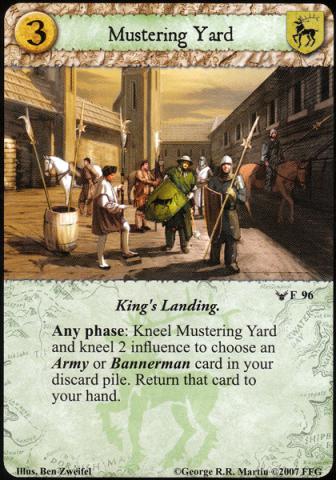
Mustering Yard (BoRF) - Extremely costly (3 gold for the location, and 2 influence per use) and requires a very specific structure from your deck. With the very limited number of available Bannermen this one mainly works in Army heavy decks, and probably the only deck that this should even be considered in is an Army-based Knights of the Hollow Hill (MotM) build. And even there you probably have much better uses for your gold.
Storm's End Tourney Grounds (TftH) - Well, at least it's cheap... but it's Card Advantage only if you have more uniques than your opponent, and even then requires you to have Joust characters. Good thing we have plenty of those in-House, right? One whole character with the printed trait (Knight of Flowers (TftH)) and one (Highgarden Squire (TftH)) that can give it. But only to a Knight. Err... Just not enough support for this card to be in any way viable. The whole thing seems more than a bit baffling, especially when compared to the other Tourney Grounds.
Highgarden Destrier (APS) - It stops you from gaining power in power challenges (in effect slowing down your Speed). Pushing through the power-challenge by a single character shouldn't be so hard with Smuggler's Cove etc. and with multiple power-challenges this could actually net you a decent number of cards in a turn. If the character weren't just controlled that is. Too bad the environment is completely toxic to non-Chain attachments currently, and the Tyrell's fed their Warhorse a bit too well...
So, what do the Baratheon character-recursion engines really provide us with? Not much, to be honest. Splintered themes, inefficient effects and broken dreams. Nothing to see here, move along.
For Shadows:
Blackwater Bay (TBoBB) - Baratheon has exactly this one engine for recursion of Shadow-cards, but thankfully it's pretty good, since it provides both card and resource advantage... and is cheap to boot. The only problem with it is how to get those cards into the discard pile to begin with, but there are tools available for that. Definitely a card to keep an eye on.
For Events:
Small Council Chamber (SaS) - Another decent event recursion engine. It may not look like much, until you see someone run an Asshai deck with 3x Condemned by the Council (AToT) and a couple of these to recur them. Now that's location control! Another good target is Questioned Claim (AE), which also happens to be Any Phase:, so it works with Robert as well.
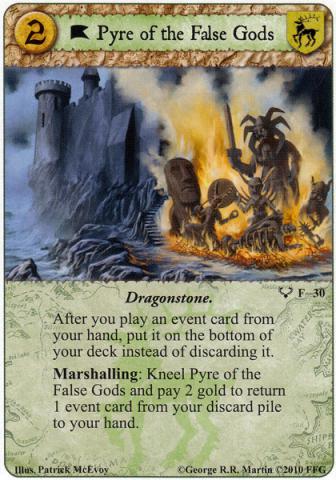
Pyre of the False Gods (KotStorm) - Similarly to Robert and the Chambers, Pyre of the False Gods is actually pretty decent, although it is a bit more costly. As an engine it's usage is quite peculiar, since you would want to only play it once you've got enough events discarded/played into your discard pile. And once your discard pile is empty, you'd want to find a way of discarding it from play, so that you could again play events... and then play another copy of the Pyre. If you're running some high impact events, like maybe Westeros Bleeds (Core) together with all the Baratheon Immune to Events or Cannot be discarded characters, this may come in handy. If the events you want to replay are Any Phase: or Small Council the other two are probably cheaper options.
So, for events, Baratheon has some pretty good recursion engines. This is actually quite important, as we can widen their usage through other cards, as we will see later on.
For Anything:
Selyse Baratheon (ASoS) - Now Selyse Baratheon is the worst kind of recursion engine, one that doesn't really generate any kind of card advantage. And she requires Summer and gold to do it. Not worth it really, unless you're running some kind of combo that relies on having particular pieces available. Otherwise? Forget about it.
Single-shot Recursion
Now, single-shot recursion effects would need to either bring back several cards or be built-into characters (or other cards that also serve another purpose) to provide you with any kind of card advantage on their own. However, they do serve other purposes in allowing you to keep your key uniques out of the dead pile, providing resource advantage etc.
More importantly, single-shot recursion can also be combined with either other recursion engines, or Card Advantage providing targets to recur, to get better use out of them.
For Attachments:
Prosperity and Plenty (Core) - Attachments aren't really worth it in the current environment, so neither will this card be. Except in Maesters, where it provides Baratheon with quite resilient Maester-builds, that is. Bonus points for combining with both Robert and the Pyre.
For characters:
To Be a Stag (SB) - Vastly inferior to it's Targaryen counterpart. The play restrictions on this card are pretty difficult to work with, and it really forces your deck into a very specific structure. Why? Because Baratheon decks tend to have a flatline 3-3-3-3... STR structure. Could work with cards like Edric Storm (Core), Loyal Guard (WotN) or even Salladhor Saan (KotStorm), but since it only returns the cards to hand, it will rarely be worth it.
Fiery Kiss (ODG) - This card is actually one of the best additions Baratheon Recursion has received in a long time. There's a few things that you should see here:
- if the character is not killed it gets moved from your dead pile to your discard pile (allowing you to play it again if it's a unique, or it's recursion via discard-pile specific methods)
- you can often kill the character for claim to save another character from dying
- this is brilliant for hammering back after a Valar, since it's virtually bulletproof while sitting in Shadows
- it also works as a brilliant finisher with cards like Robert Baratheon (Core)
- it comboes brilliantly with the Shadow recursion-engine found in Blackwater Bay (TBoBB)
Self-recursion
Royal Guard (SB) - Bad, forget about it.
Lost Captain (KotStorm) - As fuel for some discard or kill -based effects (like Wildling Bard (CD) or Glamor of Fire (ARotD)) this could become interesting in the long run. However, it is really costly to play time and again and thus puts a lot of pressure on your economy.
Royal Entourage (TTotH) - One of the best self-recursion characters in the game, really. Nothing beats watching your opponent first discard it with Dissension (QoD), only to get surprised two turns later after their Valar, when you drop a cheap Lady (like Marya Seaworth (KotStorm)) only to get it back for free. Also pretty fun to use with Fiery Kiss (ODG).
Knight of Summerhall (DB) - A really solid self-recursion character for Holy-based builds, and really the key for making Glamor of Fire work to your advantage.
Recursion Support:
In addition to having a lot of recursion effecs, Baratheon also has some interesting support for them.
Direct Support:
Maester's Tower (HtS) - Another really bizarre Baratheon card. The effect is really strong, but guess how many Learned characters Baratheon has in-House? Yep, it's one again. So the only place for this to work currently is a Maester-build, which hilariously is the Baratheon deck with the least problems with Card Advantage.
Discard Engines:
A lot of the Baratheon recursion is based on digging cards out of your discard pile. Getting them in there in the first place can sometimes be a bit problematic, especially with characters. Thankfully we have some engines for this available:
Asshai Initiate (KotStorm) - Helps keep your key uniques out of the dead pile, while simultaneously functioning as a discard engine for your recursion. Often quite undervalued really.
Lucky Bones (GotC) - If attachments weren't so weak, this might actually be pretty fun to play around with, since it provides direct card advantage on top of functioning as a discard engine.
Wildling Bard (CD) - Currently the easiest way of putting a specific card from your hand into your discard pile, while profiting from it. Works nicely with some of the self-recursion characters.
Final Thoughts:
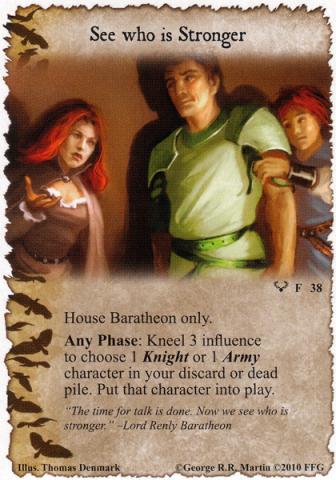
Now there are some real gems hidden within the Barathen Recursion cardpool, among the extremely inefficient and horribly limited. The Recursion builds that actually tend to work (at least to some degree) usually end up using one of the good recursion engines (events or shadows) in tandem with some of the strong single-shot recursion cards. A classic example would be a Baratheon Army build with Pyre of the False Gods (KotStorm) and Robert Baratheon (KotS) to recur See who is Stronger (KotStorm). Another possibility is to combine Fiery Kiss (ODG) with Blackwater Bay (TBoBB) to create an engine that gets you one character from your dead pile each turn.
However, the overall feeling in the cardpool tends to be one of aimless splintering. Instead of the cards working to forge a cohesive build, you're having to Jury rig together a bunch of cards that work in completely opposite directions. What other theme in the whole game can brag that it depends simultaneously on having at least: Army, Knight, non-Army, Lord/Lady, Learned, Joust, Holy, Any Phase: event, Small Council event and Shadow cards?
Forging a strong, consistent and cohesive build out of those pieces can be more than a bit difficult. Although, if you enjoy a challenge, it's also one of the most interesting deckbuilding fields in the whole game.
- Archrono, bigfomlof, JCWamma and 2 others like this


19 Comments
1) Visible structure
2) Emphasizing words using formated text
3) Classifying everything in three things
The article's content is nice. But its presentation is perfect! It was a pleasure to read it!
I don't know if this helps with the article, but Maester's Tower can be used in an Asshai deck in combination with Litany of Light (TIoR). It is not a house Baratheon only event, but there is no real Asshai presence currently outside of that house. Targ has some(maybe 2 or 3?) and Greyjoy has 1(Moqorro).
A United Cause (TBC) is another event that is recursive, but it's Melee format only and it can be used by Stark.
One could argue that For R'hllor (RotO) could used as indirect recursion support as an offensive tool. If you get hit by it when you play it, the choices you make should be with cards you can use with recursion. I could view discarding your own cards with the event as being part of the "cost" which is more of a sacrifice.
Anyways nice article!
Litany of Light (TIoR) and Maester's Tower (HtS) actually typify something that's really common in Baratheon - the cards tend to branch out towards 3-5 card combinations. However, there's a trap in that direction: without a solid draw engine you really shouldn't be relying on combos (of more than 2 cards) unless there's a lot of redundancy or alternative combinations also available.
For example in an Asshai deck you would require:
- A standing Asshai in play
- Litany of Light (TIoR) in hand
- Maester's Tower (HtS) in play
- A recursion effect to play/trigger AND anything that is required to pay for it's cost
For a House that usually draws 2-3 cards a round, that is really difficult to achieve and probably not worth the trouble. If you had access to some decent in-House Learned characters (that also fit the Asshai build), then you might have enough redundancy to try running Maester's Tower (HtS) by supporting it with Litany of Light (TIoR). Alone it just isn't enough.One of my favorite tools to use is recursion! Especially repeated cycles of recursion (Like Blackwater Bay and shadows events.)
An interesting addition to some (if not most) of these recursion tools is Maesters. (I know, you weren't covering neutral, but Baratheon has some unique interactions with everyone's favorite agenda.)
Bronze Link (FtC) and Pale Steel Link (FtC) seem to turn a lot of the currently out of favor attachment cards into viable tools.
Want to make losing dominance really hurt for your opponent? EVERY turn? Condemned (TBC) and recur it with the bronze link. How about some really surprising burn? Jump in Greyscale (tHoBaW) with the Pale Steel Link (FtC) mid challenge to force a str loss if they win the challenge, or just burn it there with the Lead Link (CbtC) or
Salla's Escort Ship (KotStorm).
Any attachment based combo deck can use the bronze link as a back up plan. (Just so you don't lose the key piece of your combo if your opponent has attachment hate.)
Attachments become a little scary when you just run those two chain attachments. Not to mention jumping in claim soak or extra str via low cost characters and the Pale Steel Link (FtC)
.
Running some maesters (I've even messed around with not running the agenda) in various deck types can add some interesting effects, but it's still usually better to run the agenda to be "safe". (So you don't choke your draw with too many attachments.)
If only the maesters tower worked on attachments and events instead of just characters! As things are now, it's a powerful boost to a tool that isn't quite there yet. (The only thing I see really working with it is
Fiery Kiss (ODG) or Glamor of Fire (ARotD) and that's a stretch.)
While not quite recursion, Bound by the Light (DB) with Asshai and Many Powers Long Asleep (RoR) is a natural combo that turns a disadvantage (satisfying claim or deadly) into an advantage. (searching an asshai character you want and putting it into play!) And as long as your claim was a holy character, then you can get it back the following turn with the plot.
Right I agree with that. The thing about what you are saying about Litany of Light is that compared to a non-Asshai build, you need a standing Learned character instead of a standing Asshai character. To me, the event is the only added piece to the Maester's tower puzzle. You still need a recursion effect, a standing learned character, and the Maester's Tower in play. The difference in the deck build is probably using a partly dedicated Asshai build compared to a dedicated Maester built with Neutral or OOH Learned characters.
Unfortunately the Maester's Tower just takes too much effort to get working for the benefit.
Yeah, even without the added complexity from needing the event the effect is already quite situational and difficult to get working properly... Basically to be in any way really usable the card would require there to be an easy repeatable effect for it to copy (think Widow's Watch (GotC) for Rickon Stark (MotA)) and a good selection of in-House or otherwise accessible Learned characters to choose from.
As it is? Exactly as you said, requires too much effort and even then ends up being really unreliable.
Stannis Baratheon (KotStorm), a card that is for me the "eternal promise". This man can bring you real card advantage, if you take into account that the cards that are "put into your hand" (i.e. The Viper's Bannermen (PotS)) are actually not draw. I wonder if a deck with a tight synergy of both cards would work
EDIT:
And if we are not sticking to Baratheon cards, Wildling Wisewoman (TWH) could also be used to hurt an opponents draw. Albeit an expensive method, but maybe it is part of a means of choking the opponent.
Off topic for the win!
Oh, and both the neutral herald and Wildling Wisewoman are definately interesting cards to look at when seeing at what neutral Recursion/Prevention options are available that could fit in Baratheon.
I think I'll not go as far as looking at OOH cards though, as that would probably bloat the whole field out to an enormous size.
I assume that you are not allowed to look at the face down duplicate attached to Ser Davos Seaworth (WLL)? I ask because if you really were interested in grabbing that card, you could use Search and Detain (HtS) to take it and be able to use it like you normally would have.
EDIT: Not that it would be worth it, but it would be an expansion on what is possible and in an inefficient way could get you a card more quickly.
I've always loved Ser Davos Seaworth (WLL) in Knight -decks, since he's one of the few cards that help you maintain board presence through Valars and also works pretty nicely with See who is Stronger (KotStorm). Bonus points for being irritating for decks that like to bounce opponent's characters.
I actually just looked at Dale and immediately ran up to the attic to dig out my old and musty Banners... "Huh, finally! This is what we've been waiting for all these years!"
Ire can attest to the fact that I've played (bad and worse) Baratheon Recursion-decks pretty much since Clash of Arms came out... So I was in a good position to note that the winds might finally be changing.